How Long Does a Cross Stitch Take? (With a Calculator)
How long does a cross stitch take? Typical stitches per hour, worked examples from bookmark to full coverage, what slows you down, and a free time calculator.
Quick answer: Divide the number of stitches by your stitches per hour. At example speeds of 150 to 300 full stitches an hour, a 10,000-stitch design takes roughly 33 to 67 hours. A small 2,000-stitch piece is a few evenings; a full-coverage 100,000-stitch piece is 333 to 667 stitching hours, or about 1.3 to 2.6 years at five hours a week. Or let StitchThis work it out from your real pace as you stitch.
Work out your time with the free cross stitch time calculator →
"How long will this take?" is the question behind every gift deadline and every big chart sitting in the stash. The honest answer depends on two numbers: how many stitches the design has, and how fast you stitch on that design. This guide gives example speeds, worked examples from a bookmark to a full-coverage portrait, the things that slow you down, and a way to measure your own pace. Want the estimate to stay right as you go? Track the project in StitchThis, and the finish date updates from your own stitching.
How many cross stitches can you do in an hour?
Speeds vary a lot from stitcher to stitcher, so be wary of precise-sounding averages. Here is what some stitchers report when they time themselves:
- A long-time stitcher who blogs at Sirious Stitches timed a typical small pattern with a few color changes, watching TV as usual, and averaged about 250 stitches an hour, varying between about 230 and 270. She describes herself as a relatively fast stitcher, so treat that as one person's rate, not a typical one (Sirious Stitches, "Speed Test: How to Measure Your Average Cross Stitch Rate and Why", 2020).
- In an r/CrossStitch discussion (May 2024), a stitcher with two to three years' experience reported about 180 stitches an hour on a simple project with large blocks of one color.
- Craft and pricing guides commonly quote 80 to 150 an hour for beginners and 150 to 300 for comfortable stitchers, though without measurements behind them.
The table below uses example speeds of 150, 200 and 300 full stitches an hour as planning scenarios, not as an average. Many stitchers work considerably slower, especially beginners and anyone on a busy chart; if that's you, time yourself (see "How to estimate your own pace" below) and use your own number.
| Stitches in the design | at 150/hour (example) | at 200/hour (example) | at 300/hour (example) |
|---|---|---|---|
| 2,000 (a bookmark or small motif) | 13 h | 10 h | 7 h |
| 10,000 (about 100 × 100, full) | 67 h | 50 h | 33 h |
| 25,000 (a medium picture) | 167 h | 125 h | 83 h |
| 50,000 (a large piece) | 333 h | 250 h | 167 h |
| 100,000 (a big full-coverage chart) | 667 h | 500 h | 333 h |
Those are stitching hours. Calendar time depends on how often you stitch, which is where most estimates go wrong: at five hours a week, the 100,000-stitch row is roughly 1.3 to 2.6 years.
Let your tracker work out your finish date
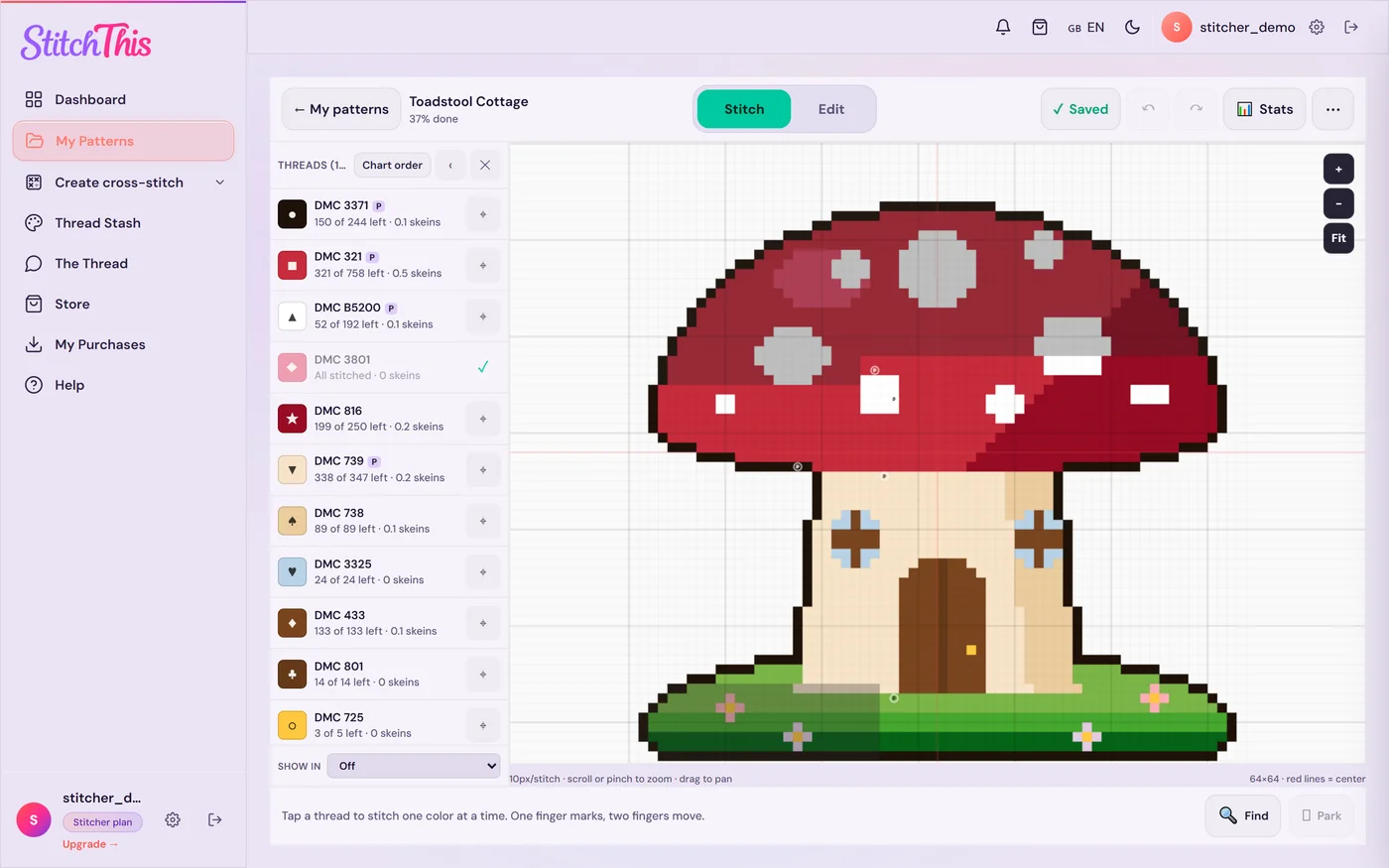
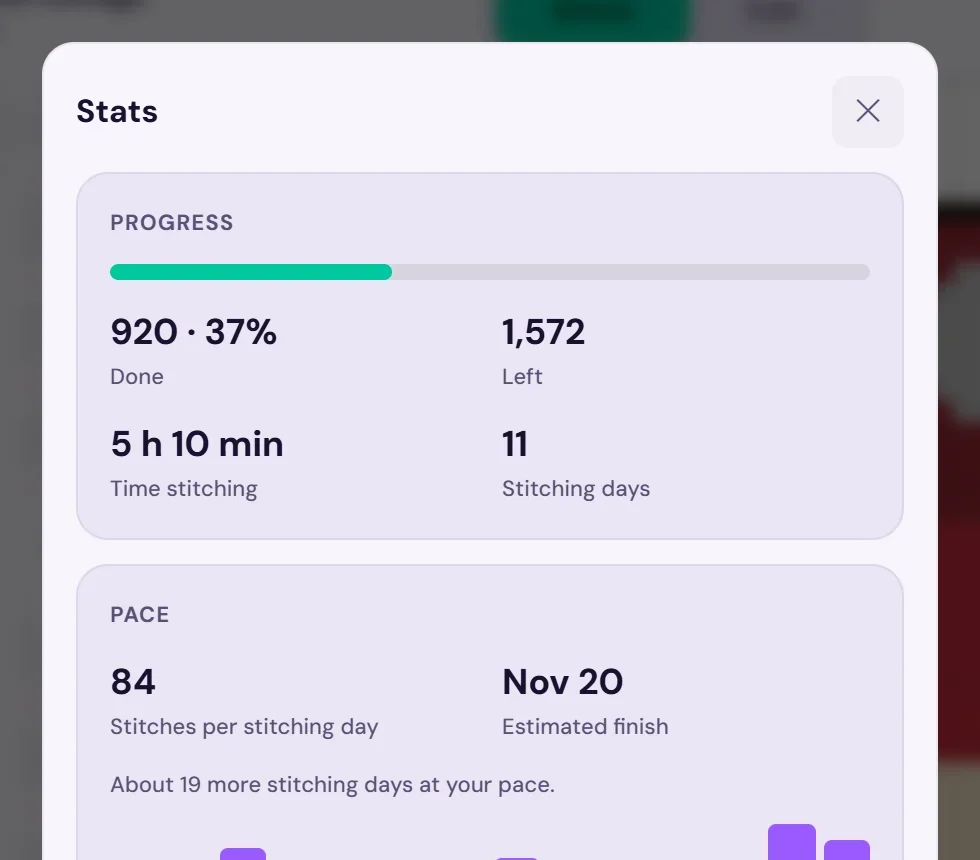
In the StitchThis progress tracker, you mark stitches on the chart with a tap, a drag across a row or a whole 10×10 block, and Stats keeps the numbers: percent done and stitches left, total time stitching, stitching days, your stitches per stitching day, a chart of the last 14 days, and an estimated finish date once you've stitched on two different days. You can set a daily goal and watch the ring fill.
The date follows how you really stitch: it works out your pace per stitching day and how often you pick the project up, so three evenings a week gives a three-evenings-a-week finish date, not an every-day one.
It works on PDF and OXS charts you import as well as patterns you make from a photo with the cross stitch pattern maker, on your phone, tablet or computer, with progress synced between them. The free plan tracks 2 patterns at a time; Stitch Tracker ($19.97 a year, renews yearly, cancel anytime and keep every chart) or Maker removes the limit. Try StitchThis free, or see the cross stitch project tracker and the PDF pattern tracker first. Not sure your PDF will import? Check which cross stitch PDFs work with tracker apps.
How long should a cross stitch take? Worked examples
A bookmark, 30 × 90, about 70% stitched. 30 × 90 × 0.7 = 1,890 stitches. At 200 an hour, about 9½ hours: a week of evenings, or one long weekend.
A medium sampler, 150 × 200, about 80% stitched. 24,000 stitches. At 200 an hour, 120 hours. At an hour a day, four months. At five hours a week, about 24 weeks: start in May for a Christmas gift.
A pet portrait from a photo, 120 × 150, full coverage. 18,000 stitches, but photo patterns have more colors and more single stitches, so a 200-an-hour stitcher may manage 150 here: 120 hours rather than 90.
A full-coverage "heirloom" piece, 300 × 400. 120,000 stitches. At 200 an hour that's 600 hours. At seven hours a week, about a year and eight months. This is why big full-coverage charts are famous for taking years: the stitching isn't harder, there's just a lot of it.
To get the stitch count of your own chart, add up the stitch counts in the key, or estimate width × height × the share of the fabric that's stitched. For the size it'll come out on your fabric, see stitch count to inches or the cross stitch calculator.
Why does cross stitch take so long? What changes your speed
The same stitcher can be twice as fast on one chart as another. The usual suspects:
- Color changes and confetti. Every color change means switching threads: ending one and starting another, or bringing up a thread you parked. A chart with lots of single stitches of a color ("confetti") can slow you down a lot; as a rough planning assumption, allow up to twice the time. See how to read confetti-heavy patterns.
- Number of colors. Fifty similar shades mean more checking of the key and more mistakes to unpick. Our color palette selection guide explains why fewer, well-chosen colors stitch faster and often look better.
- Fabric count. 18-count fabric has smaller holes and is harder to see than 14-count; many stitchers are slower on it. The Aida 14 vs 16 vs 18 comparison covers the trade-off.
- Finding your place. Counting from the last bold grid line, losing your place between pages, and hunting for the next "▲" all eat time without adding stitches.
- Method. Stitching one color across a big chart means long searches and carries; on busy charts many stitchers find the parking method faster once they're in a rhythm.
- Extras. Backstitch, fractional stitches, French knots and beads aren't in the stitch count but take real time. As a rough planning assumption, add 10 to 20% on a chart that uses a lot of them.
- Fatigue and light. Pace drops late in a session and in poor light. Two short sessions often beat one long one.
If a chart feels like a slog for no clear reason, why cross stitch patterns feel miserable diagnoses the common culprits.
How to estimate your own pace
- Pick the project you're estimating. Your pace on a confetti portrait isn't your pace on a sampler.
- Stitch for 30 to 60 minutes as you normally would, including thread changes and checking the chart. Don't race.
- Count the stitches you finished. Divide by the minutes and multiply by 60.
- Repeat on another day and average the two. One session is noisy.
- Plug it into the time calculator with how many hours a day or week you really stitch, not how many you'd like to.
Or skip the counting: a tracker counts as you mark. In the cross stitch tracker spreadsheet you log stitches and minutes per session and it works out stitches per hour and a finish date; in an app it happens as you go.
How to cross stitch quicker
- Stitch in rows, not single crosses. Work a row of half stitches (////), then come back across (\\\\). It's faster than finishing each cross on runs of the same color, and gives an even look.
- Use the right thread length. About 18 inches (45 cm). Longer threads tangle and wear; shorter means more starts.
- Use the loop start for two-strand stitching: fold one strand in half, thread the two ends, and catch the loop on the back with your first stitch. No knot, no tail to weave.
- Try parking on busy charts. The parking method can cut starts, stops and searching on confetti-heavy designs.
- Highlight one color. Seeing every square of the current color at once beats scanning for symbols. On paper, a colored pencil works; in a tracker app, highlight the thread and gray out the rest.
- Keep your place. Mark what you've done after every session, on paper or on screen. Our guide to tracking cross stitch progress compares methods.
- Prepare your floss. Sorted, labeled floss saves minutes every session; see the floss stash organization guide. Check what you own before you start, too: the free floss stash tracker takes a CSV of your existing list or photos of your skeins, so a missing color doesn't stall the project halfway.
- Choose the chart to suit your deadline. Fewer colors, more blocks of color, bigger squares. If you're making a pattern from a photo, a smaller size or fewer colors saves hours; the resize to fit a frame guide shows how size drives the count.
- Rotate WIPs on purpose. A fast, simple project between two hard ones keeps your momentum up. See managing multiple WIPs.
Frequently asked questions
How long does it take to cross stitch a 100 × 100 pattern? A full-coverage 100 × 100 design is 10,000 stitches: about 33 to 67 hours at example speeds of 150 to 300 stitches an hour. With background left unstitched, scale it down by the share that's stitched.
How long should a beginner cross stitch take? Guides often suggest 80 to 150 stitches an hour for beginners, so a 2,000-stitch starter kit might take roughly 13 to 25 hours; time yourself to find your own pace. Speed comes quickly; the beginner's guide covers the habits that help.
Why does cross stitch take so long? Mostly sheer numbers: a medium picture can hold 25,000 stitches, each made of two passes of the needle. Color changes, confetti and finding your place add the rest.
How many hours a day do people cross stitch? It varies hugely. An hour on a weeknight is common; use your own real schedule in the calculator, not an ideal one.
Is there a cross stitch time calculator? Yes. The free cross stitch time calculator takes the design size or stitch count, your pace and your schedule, and gives the hours, calendar time and a finish date.
How do I work out my cross stitch finish date? Stitches left ÷ stitches per day = days left, adjusted for how many days a week you stitch, added to today. StitchThis does it for you from your real pace and how often you stitch; the tracker spreadsheet does it if you log your sessions.
Does fabric count change how long it takes? The number of stitches is the same on any count. Higher counts make the same chart physically smaller and lower counts make it larger, and the smaller holes on 16- and 18-count can slow some stitchers down.
Make the deadline (or enjoy the long haul)
Count the stitches, time yourself honestly, and give the estimate some slack for backstitch and busy evenings. Then track it, because the estimate gets better every week you stitch. Comparing tools? See cross stitch tracker apps compared, Pattern Keeper alternatives, and the tracker for PC and tracker for iPad pages.
Ready to see your real finish date? StitchThis is the full cross stitch platform: your charts and progress on every device, a finish date that follows your pace, your floss stash, and patterns to buy or make next. Start tracking free in StitchThis.
Вече имаш схема като PDF?
Качи я в StitchThis и бродирай по нея на екран: приближавай всяка част, отбелязвай бодовете в движение и продължавай откъдето спря.
Импортирай PDF безплатноБезплатен план: пази 2 импортирани схеми и проследявай 2 схеми едновременно, без срок. Не е нужна карта.