How many strands of embroidery floss should I use?
Two strands suit most hoop embroidery: outlines, small satin areas and shading. Use one for fine detail and three to six for bold lines, big fills and chunky knots.
Hand embroidery guide
The pattern just says “floss,” the skein has six strands twisted together, and your satin stitch looks either thin and gappy or thick and lumpy.
Use this chart to pick the strand count for each stitch and look, match it to a needle, and work out how much floss you need.
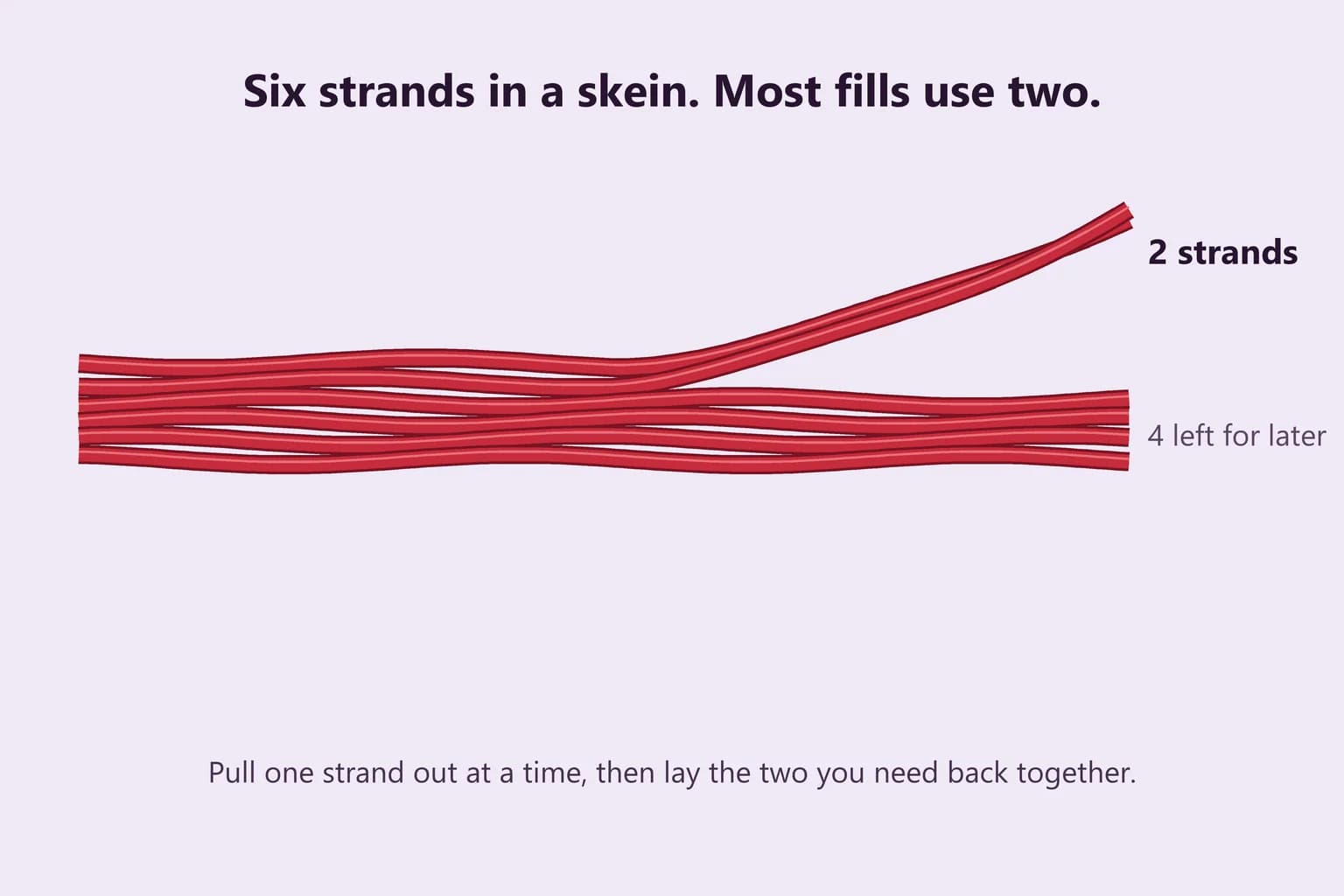
Embroidery floss is six thin strands twisted loosely together. You almost never stitch with all six: you separate them and recombine as many as the stitch needs. Fewer strands give finer, smoother detail; more strands give bold, raised texture and cover faster.
| Strands | Look | Good for |
|---|---|---|
| 1 | Very fine and delicate | Tiny details, faces, fine shading in thread painting, lettering on small pieces |
| 2 | Fine but clearly visible | Backstitch outlines, stem stitch, small satin areas, long & short shading, most hoop art |
| 3 | Medium, fuller coverage | Larger satin and fill areas, chain stitch, lazy daisy petals |
| 4 | Bold | Thick outlines, chunky fills on heavier fabric |
| 5–6 | Heavy and raised | Bold French knots, statement lines, couching laid threads, textured clothing details |
Practice varies: these are starting points. Stitch a short test row and adjust.
Two or three strands lie smoothly side by side. Keep each stitch under about 1 cm (3/8 in) or it will snag; for wider areas switch to long & short. See satin stitch.
Want a bigger knot? Add strands rather than wraps: one to three wraps is plenty. Don’t take the needle down in the exact hole you came up, or the knot pulls through. See French knots.
One or two strands blend colors softly; more strands make the steps between shades show. See long and short stitch.
One strand for fine detail, two for most outlines, three or more when the line should read from across the room. See backstitch.
Fine, tightly woven fabrics such as lightweight cotton and linen suit one to three strands; thick strands drag and leave holes. Heavier fabrics such as canvas, denim or linen-cotton blends can take four to six strands without the stitches sinking in.
The needle has to open a hole big enough for the thread to pass without fraying. Embroidery (crewel) needles have a long eye for several strands. As a rough guide: size 9 or 10 for one or two strands, 7 or 8 for two to four, and 5 or 6 for five or six. StitchThis patterns suggest a size 7–9 embroidery needle.
About 18 inches (45 cm), or roughly from your fingertips to your elbow. Longer lengths fray and knot.
Hold the cut end, pinch out a single strand and pull it straight up. The rest bunches up and then relaxes again.
Lay the strands you need side by side, ends level, and thread them together. Separating and recombining (“stripping”) makes the floss lie flatter and cover better.
Every hand embroidery pattern StitchThis makes from your photo uses two strands of six-strand floss throughout. Two strands are fine enough for the shading and detail of a photo-based design, full enough to cover satin and long & short fills, and one setting means you never have to re-separate floss mid-project. Crewel and Persian wool patterns use one strand of wool.
Skein counts in the pattern come from the stitches themselves: the length of thread on the front, times 2.1 for the thread that travels on the back, times the strands, plus 15% for waste and a quarter skein spare. A DMC skein is 8 meters of six strands. If you use more strands than the pattern says, buy more floss.
Want to use a different thread brand? The floss converter finds the closest match in eight brands.
Two strands suit most hoop embroidery: outlines, small satin areas and shading. Use one for fine detail and three to six for bold lines, big fills and chunky knots.
Two or three strands usually give smooth coverage. Keep individual stitches under about 1 cm (3/8 in) so they don’t snag.
Two to three strands for small to medium knots, more for big ones. Add strands rather than wraps to make a knot larger.
Yes, for most stitching. Pull the strands apart one at a time and put back together as many as you need; it lies flatter even if you then use all six.
A DMC skein of six-strand cotton is 8 meters long. Stitching with two strands gives you three times as much working thread as six.
About 18 inches (45 cm). Longer pieces twist, fray and knot before you use them up.
Making and editing a pattern is free with a StitchThis account. Saving it or downloading the PDF uses a pattern credit ($5.99 per pattern, or 5 for $20). Embroidery is included in Maker ($5.99/month) and in Craft Unlimited, with unlimited patterns.