
StitchThis
자수십자수커뮤니티요금제
로그인무료로 가입하기
  1. Home
  2. ›Embroidery
  3. ›Stitches

Free stitch guide

Embroidery Stitches: A Visual Guide to the Stitches That Matter

Stitch dictionaries list hundreds of stitches, and none of them tell you which one to use for the petal, the sky or the outline in front of you.

Here are the 21 hand embroidery stitches our patterns use, grouped by job, with step-by-step guides to the five you’ll stitch most and a simple way to choose a stitch for any shape.

Make my embroidery patternRead the guide
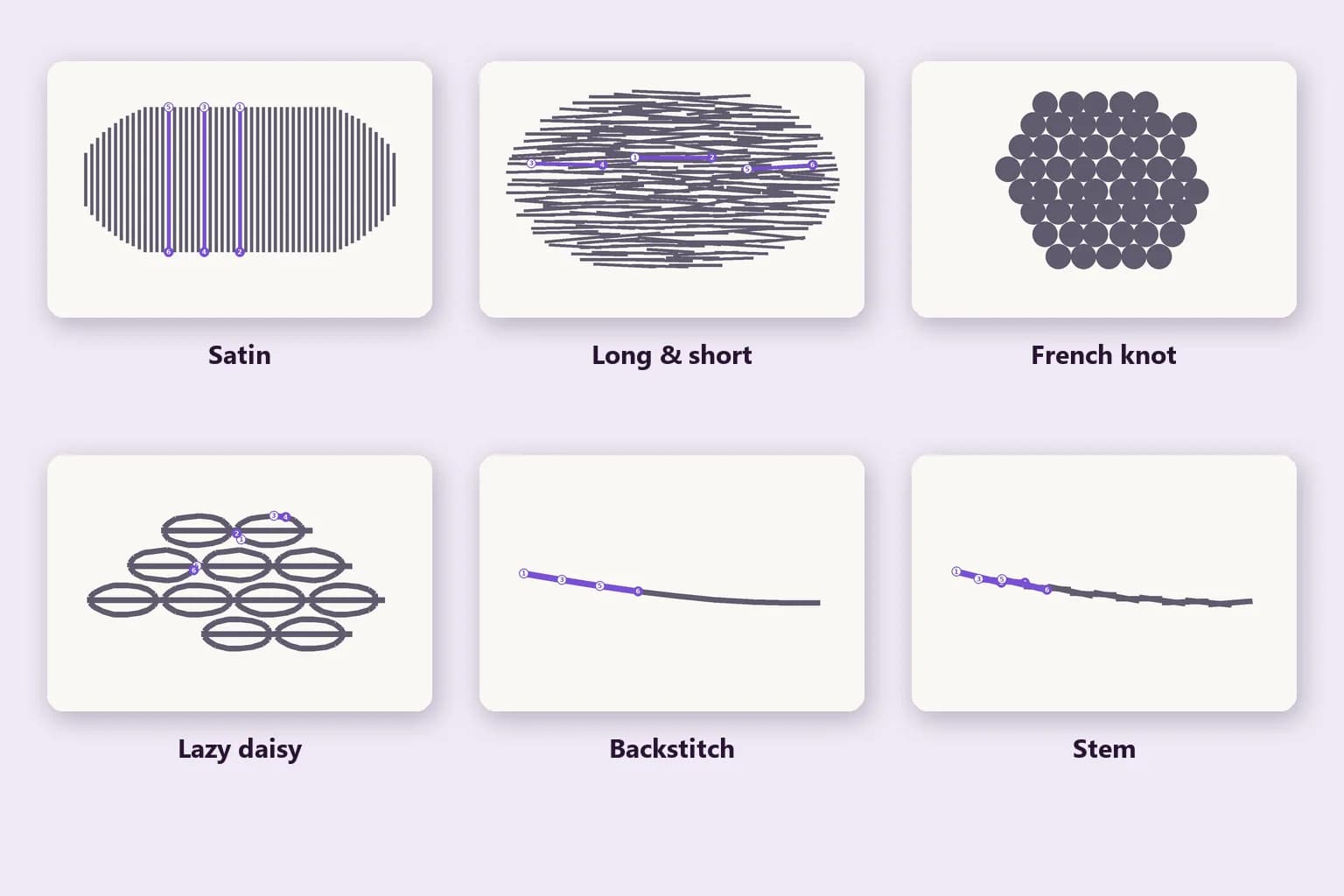
Six stitch diagrams from StitchThis patterns: satin, long and short, French knot, lazy daisy, backstitch and stem stitch

The 21 stitches, grouped by what they do

Most embroidery stitches do one of four jobs. Fills cover an area with thread. Line stitches draw outlines, stems and lettering. Raised and detached stitches sit on top of the fabric as dots, loops and coils. Border stitches make decorative bands along a line or an edge. Once you know which job a part of the design needs, the choice narrows to two or three stitches.

These are the 21 stitches StitchThis patterns use. Every one is explained with a numbered diagram in the PDF of any pattern that uses it.

Hand embroidery stitches by family
StitchFamilyBest forDifficulty
SatinFillSmall, smooth shapes: petals, leaves, lettersMedium
Long and shortFillWide areas and soft shading (thread painting)Harder
FishboneFillLeaves, with a vein down the middleMedium
French knotRaisedDots, flower centers, textureMedium
Lazy daisyDetachedSmall petals and leavesEasy
Bullion knotRaisedRosebuds, coiled petals, little caterpillarsHarder
Woven wheelRaisedRound, raised rosesEasy
Spider webRaisedRidged round roses and buttonsMedium
BackstitchLineOutlines, lettering, fine detailsEasy
StemLineStems, curves and soft rope-like linesEasy
RunningLineDashed lines, quick outlines, quilting looksEasy
SplitLineSmooth lines and edges under satin or long and shortEasy
ChainLineBold lines; rows of it fill an areaEasy
CouchingLineThick or special threads laid along a lineEasy
CrossBorderRows of X’s along a bandEasy
BlanketBorderEdges, appliqué and scalloped bordersEasy
HerringboneBorderWide crossed bandsMedium
ChevronBorderZigzag bands with a bar at each pointMedium
FernBorderFronds and branching linesEasy
FeatherBorderBranching, airy lines and crazy-quilt seamsMedium
CretanBorderPlaited bands and leavesMedium

Difficulty is how long most stitchers take to get it looking even, not how complicated the needle path is.

Step-by-step guides to the five you’ll use most

  • French knot

    The dot of embroidery: flower centers, eyes, texture. How to do a French knot without it pulling through.

  • Satin stitch

    Smooth, glossy fills for small shapes. How to satin stitch with neat edges and no gaps.

  • Lazy daisy

    One anchored loop makes a petal or a leaf. How to work lazy daisy petals that sit evenly.

  • Long and short stitch

    The thread-painting fill for wide areas and blended color. How to do long and short stitch with no visible rows.

  • Backstitch

    Clean lines for outlines and lettering. How to backstitch with even stitches and smooth curves.

See your own photo as a hand embroidery pattern: stitches, directions, threads and a printable transfer.

Try the pattern maker

How to choose a stitch for an area

  • Width decides the fill

    Satin stitch looks best when every stitch is shorter than about 1 cm (3/8 in); longer stitches snag and sag. Anything wider wants long and short stitch, or the shape split into smaller sections.

  • Thin parts want a line stitch

    Stems, outlines and lettering are lines, not fills. Backstitch gives a crisp line, stem stitch a softer rope that follows curves, split stitch a smooth line that can sit under a fill.

  • Tiny parts want a detached stitch

    A dot is a French knot, not a tiny satin circle. A small petal is one lazy daisy loop. They are faster and look more like the real thing.

  • Texture tells the story

    Smooth satin reads as petals or polished surfaces, long and short as fur, feathers and skin, knots as moss, seeds or curls. Pick the texture of the thing, not just its color.

  • Direction catches the light

    Floss shines along its length, so stitches that change angle look lighter or darker in the same color. Lay fill stitches the way the fur grows or the petal curves, and keep neighbors at different angles so shapes read apart.

Strand count changes all of this too: more strands make bolder lines and faster fills, fewer give finer detail. Our guide to how many strands of floss to use covers it stitch by stitch.

How our pattern generator picks stitches by shape

When you turn a photo into a hand embroidery pattern on StitchThis, the generator splits the picture into stitchable shapes and chooses a stitch for each one with the same rules as above:

  • Wide areas get long and short stitch for soft shading.
  • Narrower fills get satin stitch.
  • Thin lines and stems get stem stitch.
  • Small petal-shaped bits get lazy daisy.
  • Dots get French knots.

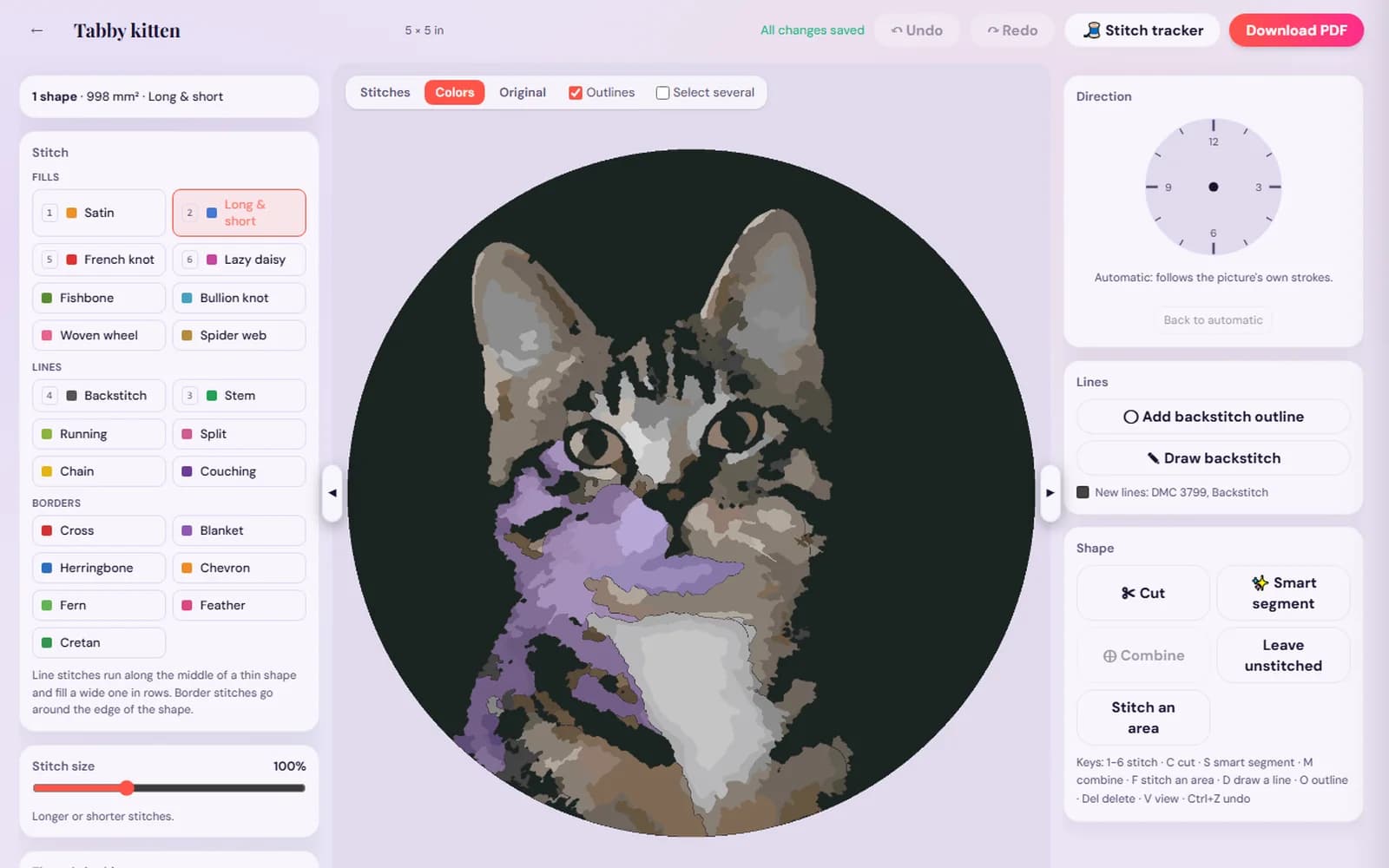
Every fill also gets a stitch direction. In the editor you can click any shape and change it to any of the 21 stitches, turn its direction on a clock-face wheel, add outlines or draw your own backstitch lines. The PDF then explains each stitch you used, with a numbered diagram. Make a hand embroidery pattern from your photo to see which stitches your picture gets.

The StitchThis embroidery editor with a design split into shapes and a drawer of stitches to choose from
Click a shape to swap its stitch or turn its direction; the stitch drawer lists all 21.

What order to work the stitches in

Embroidery is built from the back of the scene to the front, so later stitches cover the edges of earlier ones. Our patterns list the order for you, with a thumbnail per step:

  1. 1

    Big fills first

    Long and short and other large fills lay the background and the main forms.

  2. 2

    Smaller fills

    Satin and fishbone shapes sit on top of the big fills’ edges.

  3. 3

    Raised stitches

    Lazy daisies, bullions, woven wheels and spider webs go on top of the fills.

  4. 4

    French knots

    Knots come late so nothing snags or flattens them.

  5. 5

    Lines and outlines last

    Stems, details and outlines finish the piece and tidy every edge they cross.

Frequently asked questions

What are the basic embroidery stitches for beginners?

Start with backstitch, stem stitch, satin stitch, the French knot and the lazy daisy. Between them they draw lines, fill small shapes, make dots and make petals, which covers most simple floral designs.

How many embroidery stitches are there?

Hundreds, counting named variations. Most designs need only a handful; StitchThis patterns draw from 21 that cover fills, lines, raised stitches and borders.

What is the easiest embroidery stitch?

Running stitch, then backstitch. Both are just the needle going up and down along a line, and backstitch gives a solid line that looks finished.

What stitch is best for filling large areas?

Long and short stitch. Its staggered rows cover wide shapes without long loose stitches and let one color blend into the next. Satin stitch is better kept to shapes under about 1 cm (3/8 in) across.

What is the difference between satin stitch and long and short stitch?

Satin stitch spans a shape edge to edge in one pass, so it suits narrow shapes. Long and short works in staggered rows that split into each other, so it can cover any width and shade between colors.

What is the best stitch for outlines?

Backstitch for crisp, even outlines and lettering; stem stitch for smooth curves and stems; split stitch when the outline will sit under or beside a fill.

Do I need to know all 21 stitches to use a StitchThis pattern?

No. A pattern uses only the stitches it needs, and the PDF has a numbered diagram and instructions for each one. You can also swap any shape to a stitch you already know in the editor before you save.

Keep going

  • How to Do a French Knot That Doesn’t Pull ThroughA French knot is four moves and one habit: go down beside the hole, not in it, and keep the wraps snug until the…
  • How to Satin Stitch: Smooth Fills with Clean EdgesSatin stitch is simple stitches laid side by side. The smooth finish comes from a few habits: keep stitches short,…
  • Lazy Daisy Stitch: How to Embroider Neat Petals and LeavesA lazy daisy is one loop held down by one tiny stitch. Get the loop snug and plan where the petals go, and you have a…
  • Long and Short Stitch: How to Thread Paint Soft ShadingLong and short stitch blends because each row splits back into the one before. Stagger the lengths, follow the…
  • How to Backstitch in Embroidery: Neat Lines, Smooth CurvesBackstitch is the simplest solid line in embroidery. Even lengths, shared holes and shorter stitches on curves make…

All embroidery guides and tools

Turn your photo into a hand embroidery pattern

Making and editing a pattern is free with a StitchThis account. Saving it or downloading the PDF uses a pattern credit ($5.99 per pattern, or 5 for $20). Embroidery is included in Maker ($5.99/month) and in Craft Unlimited, with unlimited patterns.

Make my embroidery patternCreate a free account
StitchThis

십자수 창작자를 위한 올인원 디지털 작업 공간.

자수

  • 사진으로 자수 도안 만들기
  • 자수 스티치
  • 도안 옮겨 그리기
  • 실 변환기
  • 자수 가이드 전체 보기

코바늘

  • Garment Pattern Maker
  • Sweater Pattern Generator
  • Beanie Calculator
  • Yarn Calculator
  • Photo to Crochet Pattern
  • Chart Maker
  • Graphgan Pattern Maker
  • C2C Pattern Maker
  • Symbol Chart Maker
  • Amigurumi Pattern Generator
  • Photo to Amigurumi
  • Stitch Fiddle Alternative

제품

  • 도안 만들기
  • StitchSense
  • 도안 스토어
  • 커뮤니티
  • 요금제

회사

  • 소개
  • 문의하기
  • 도움말
  • 고객 지원

법적 고지

  • 이용약관
  • 개인정보 처리방침

© 2026 StitchThis. 모든 권리 보유.

전 세계 십자수 하는 분들을 위해 정성을 담아 만들었어요.