How Much Floss Do I Need? Cross-Stitch Floss and Fabric Size Calculator Guide
How much floss to buy, what size fabric to cut — the cross-stitch math explained simply. Formulas, examples, quick-reference tables, and the smart way to skip the spreadsheet.
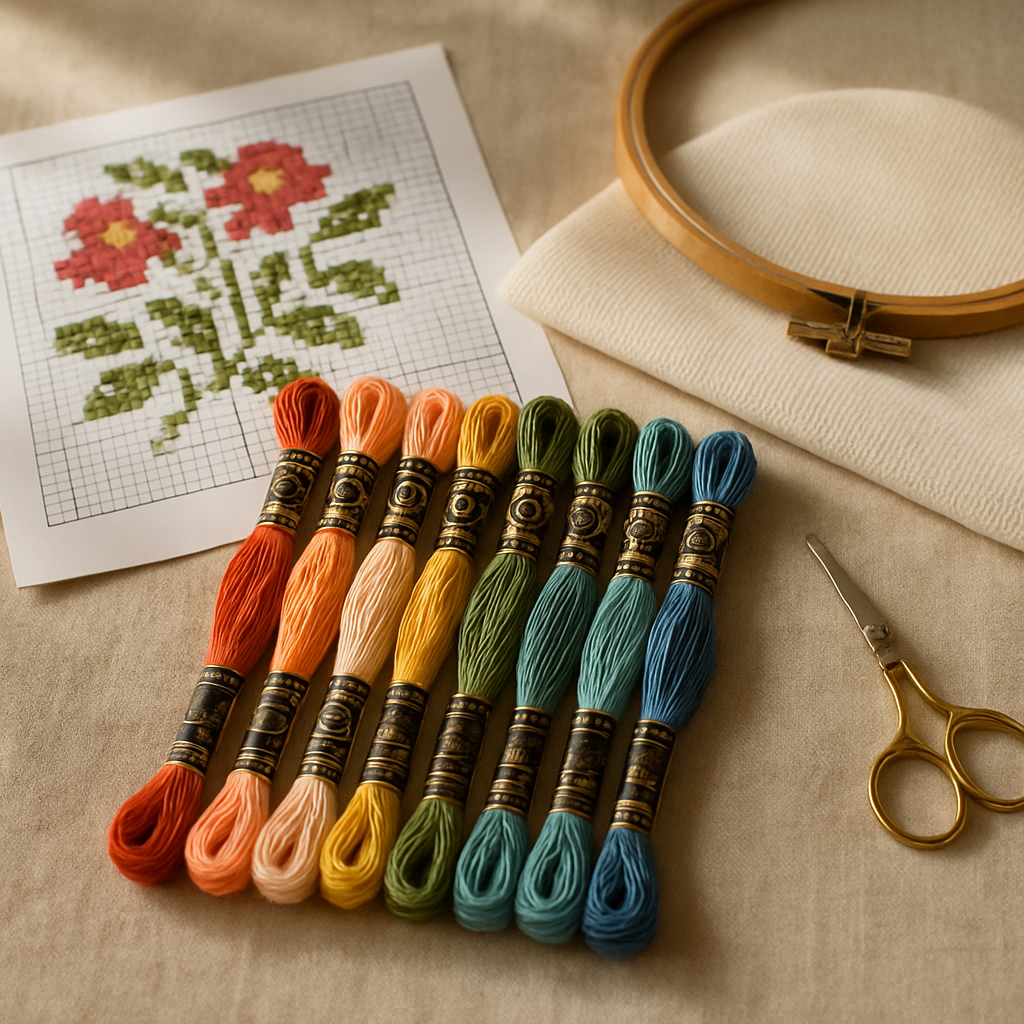
You found a pattern you want to stitch. Now you need to figure out two things before you can start: how much fabric to cut, and how many skeins of each color to buy. Both questions have clean math behind them, and once you know the formulas you'll never over-buy or run out mid-project again.
This guide covers the floss-amount math, the fabric-size math, the differences between Aida and evenweave that change both calculations, the variables that trip people up (backstitch, fractional stitches, margins), and the workflow shortcut that makes the whole calculation automatic if you don't want to do it by hand for every project.
The short answer
If you just want the formulas, here they are:
Fabric size needed (Aida):
Fabric width = (Pattern width in stitches ÷ Fabric count) + 6 inches margin
Fabric height = (Pattern height in stitches ÷ Fabric count) + 6 inches margin
Floss skeins needed (per color, 14 count Aida, 2 strands):
Skeins per color ≈ (Stitches of that color ÷ 1,000), rounded up
Both rules work for the most common case (Aida fabric, 2 strands of floss, average tension, regular cross-stitches only). Everything else — fractional stitches, backstitch, different fabric counts, French knots, beads — adjusts these numbers up or down. The rest of this guide walks through each adjustment.
How a skein actually breaks down
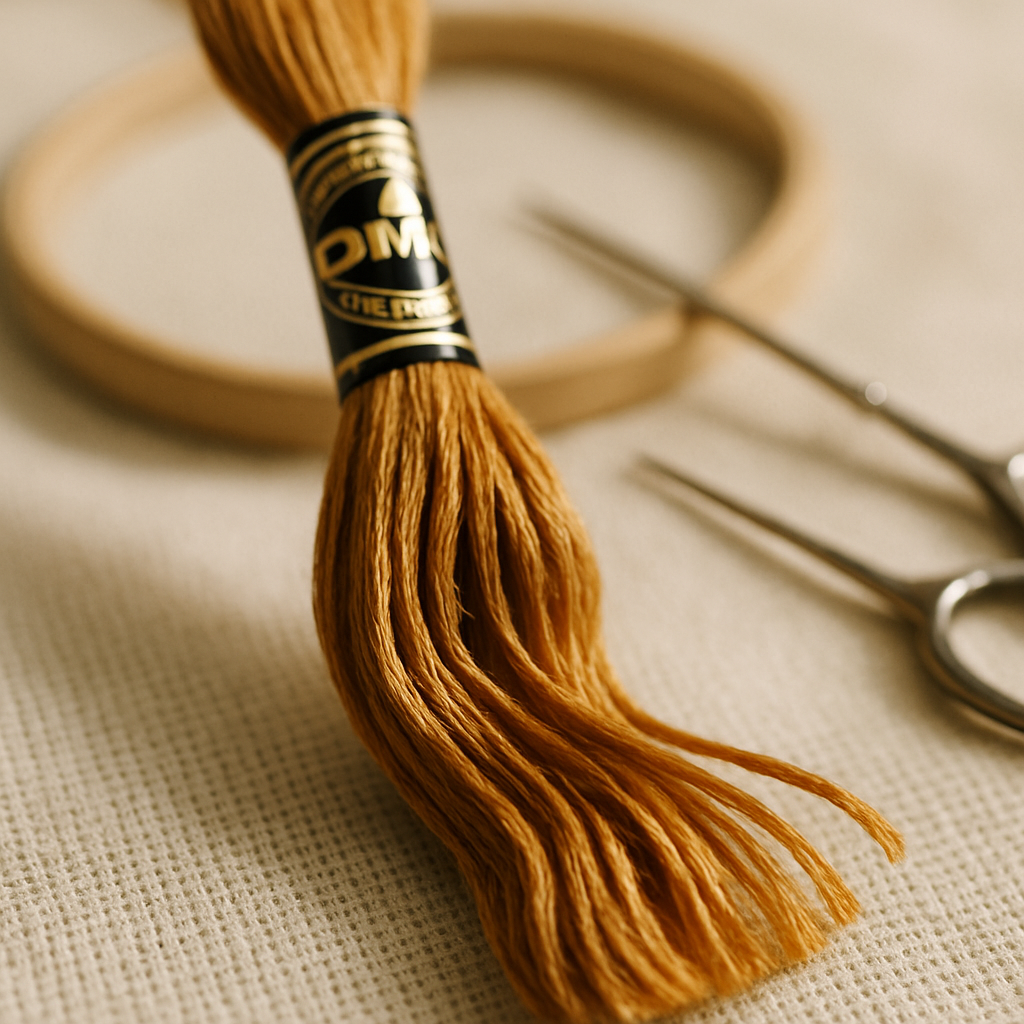 A standard skein of DMC, Anchor, or any major-brand six-stranded cotton floss contains roughly 8 metres (about 8.7 yards) of thread. That thread is composed of 6 strands twisted together. When you stitch cross-stitch, you separate the strands and use only some at a time — typically 2 strands for the cross-stitches and 1 strand for backstitch on most fabric counts.
The practical implication: each skein contains effectively 6 × 8m = 48 metres of single-strand thread, or about 24 metres of 2-stranded thread (the form you'll actually be stitching with). That's the working number.
How many stitches does that yield? On 14 count Aida, a single cross-stitch made with 2 strands consumes roughly 2 centimetres of 2-stranded thread when measured carefully (one diagonal up the front, one diagonal back across to complete the cross, plus the small bit on the back that ties stitches together). 24 metres ÷ 0.02 metres per stitch = approximately 1,200 stitches per skein in ideal conditions, dropping to about 1,000 stitches per skein once you account for thread waste, knots, and the inevitable inch or two of unusable end on every length.
So the working rule: one skein covers about 1,000 cross-stitches on 14 count Aida with 2 strands. This is the foundation for every floss-yardage calculation that follows.
The floss-per-color formula
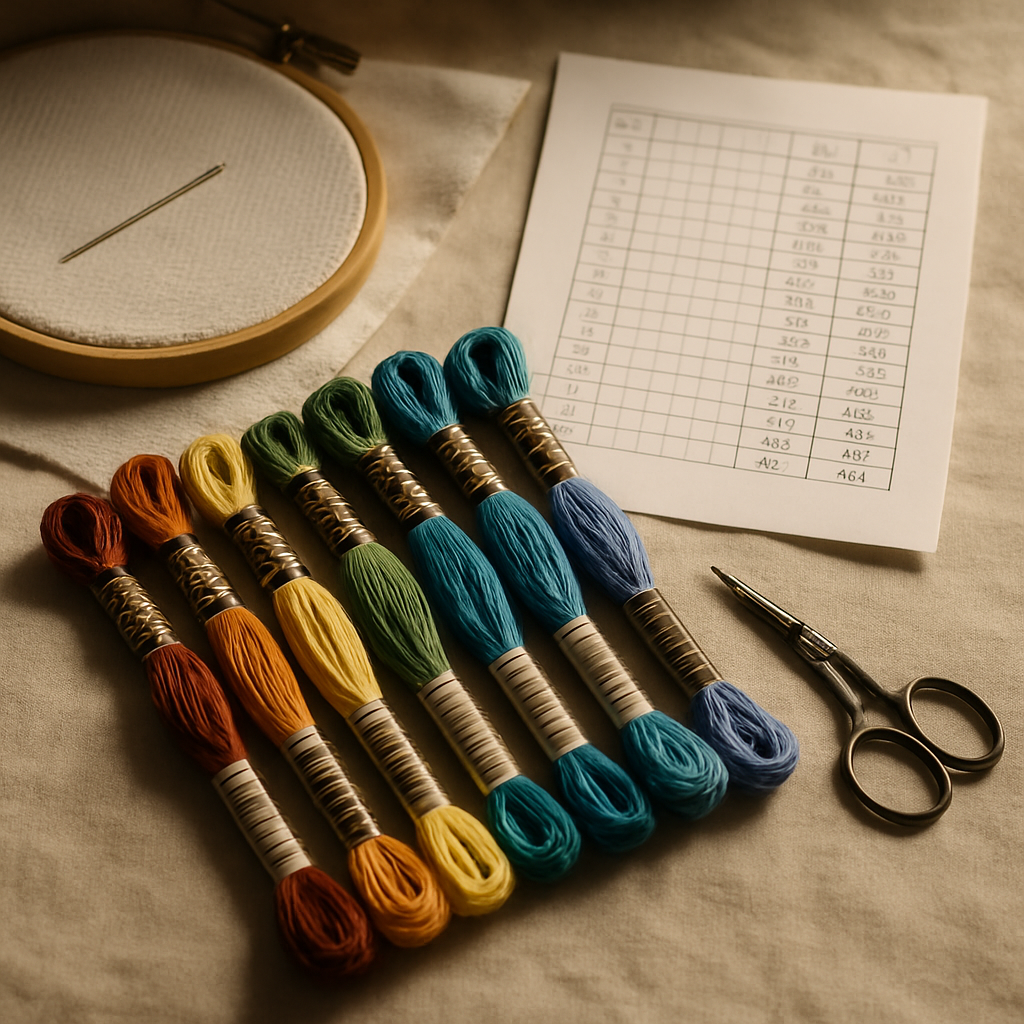 To calculate how many skeins of a specific color you need:
- Find the stitch count for that color in the pattern. Most modern patterns list this in the legend. If the pattern doesn't, count the symbols of that color on the chart (tedious but accurate) or estimate by eye from the colored preview if one exists.
- Divide by 1,000 (the stitches-per-skein figure for 14 count Aida).
- Round up to the nearest whole skein.
Example: A pattern's legend shows DMC 310 (black) with 2,400 stitches. 2,400 ÷ 1,000 = 2.4, rounded up to 3 skeins.
Always round up. Running out of a color mid-project means a special trip to the craft store and a dye-lot risk — even within the same color number, different production batches of floss can show subtle differences that are visible on the finished piece. Buy one extra skein of any color where you're close to a skein boundary, and stitch with confidence.
For a pattern with 30 colors, you'll do this calculation 30 times. The output is your shopping list — what colors and how many of each. A pattern with the stitch counts already in the legend makes this trivial; a pattern without them turns into a counting exercise.
Adjusting for fractional stitches
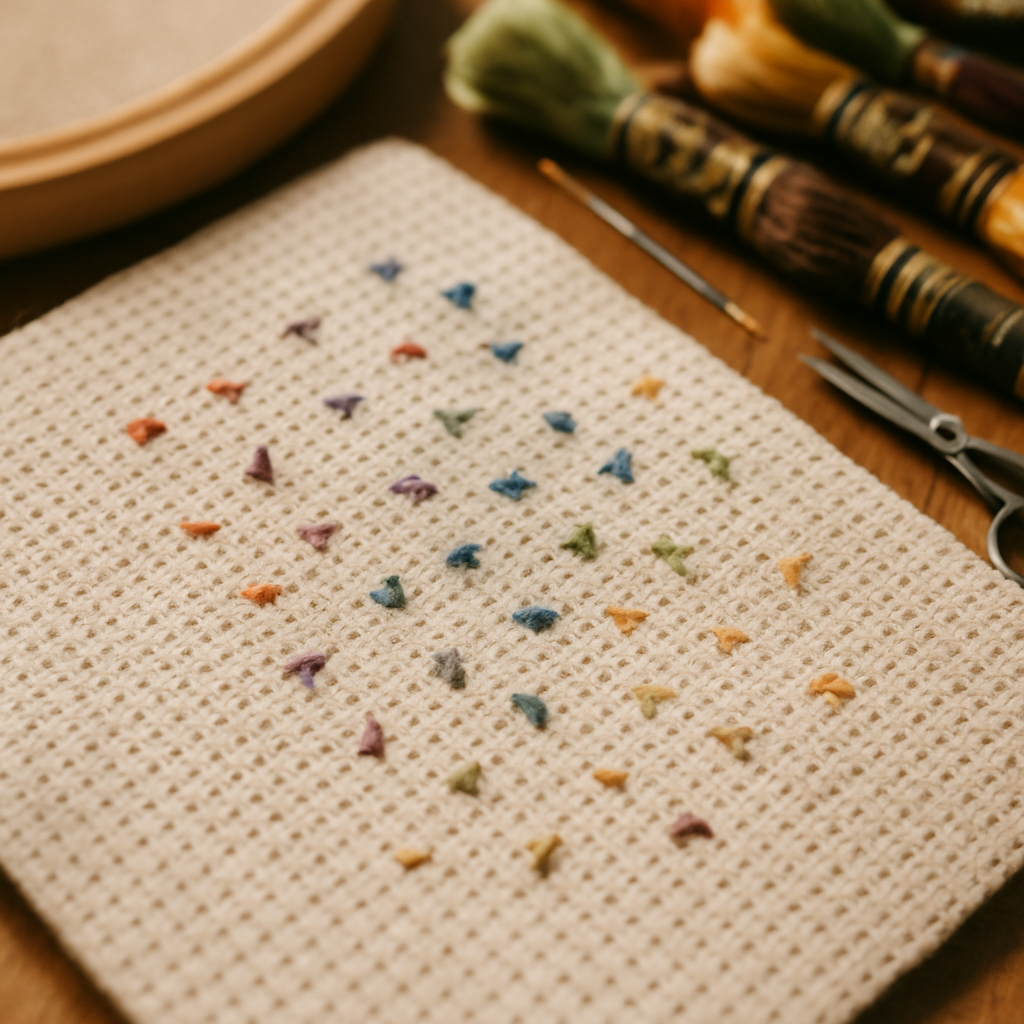 Fractional stitches (quarter, half, three-quarter) consume less thread than full cross-stitches because they cover less ground:
- A quarter-stitch uses about ⅓ the thread of a full cross-stitch
- A half-stitch uses about ½ the thread
- A three-quarter stitch uses about ¾ the thread
If a pattern is heavy on fractionals — common in portrait and landscape work — the per-skein stitch count effectively rises. A pattern with 30% fractional stitches yields about 10–15% more stitches per skein than a pattern made entirely of full cross-stitches. The 1,000 stitches-per-skein figure becomes more like 1,100–1,150 in practice.
For most cases this falls within the safety margin you get from rounding up. If a pattern is exceptionally heavy on fractionals, you might find yourself with one extra skein of every color at the end of the project, which is a happy problem to have. Add it to your stash.
Estimating backstitch yardage
Backstitch is a different calculation because it uses 1 strand instead of 2. One skein of single-strand floss covers roughly twice as much stitching distance as the same skein used at 2 strands — about 2,000 backstitches worth on 14 count Aida.
For most patterns, backstitch is the outline color (often a single color used for all backstitch — typically DMC 310 black or 938 dark brown) and the total backstitch length is hard to count from the chart. A rough estimate: one skein of backstitch color covers a moderately-outlined pattern up to about 200×200 stitches. For larger pieces or patterns with multiple backstitch colors, scale up proportionally.
A typical 200×200 portrait pattern uses 1 skein for backstitch and 1–4 skeins of each major cross-stitch color, plus 1 skein each for minor accent colors. For most patterns, the backstitch color is the only one where 1 skein is reliably enough.
Fabric size formula
For the fabric you need to cut:
Stitched area width = Pattern width in stitches ÷ Fabric count
Stitched area height = Pattern height in stitches ÷ Fabric count
Total fabric width = Stitched area width + 6 inches (3" margin per side)
Total fabric height = Stitched area height + 6 inches (3" margin per side)
Example: A 100×140 stitch pattern on 14 count Aida.
- Stitched width: 100 ÷ 14 = 7.1 inches
- Stitched height: 140 ÷ 14 = 10 inches
- Fabric width to cut: 7.1 + 6 = 13.1 inches
- Fabric height to cut: 10 + 6 = 16 inches
Buy or cut the next standard size up — most stores sell Aida in 18×27 inch and larger pre-cut pieces, so you'd grab the smallest size that comfortably exceeds 13×16.
The 3-inch margin per side is the conservative choice. It's enough for:
- Stretching on a hoop or frame without crushing the design against the edge
- Framing with a window mat
- Finishing into a finished piece (pillow, ornament, hoop display) without running out of fabric at a critical fold
- Mistakes that need correction near the design edge
If you're certain you'll be framing without a hoop and the design will be edge-mounted, you can drop to 2 inches per side. If you're new to stitching or planning to use a hoop, stay with 3 inches. Fabric is cheaper than a re-do.
How fabric count changes both calculations
Fabric count — 14, 16, 18, 25, 28, 32 — affects everything because it determines both the finished size of the design and the amount of thread per stitch.
On finished size: A 100×100 pattern is 7.1×7.1 inches on 14 count Aida, but only 5.6×5.6 inches on 18 count. Higher count = smaller finished piece. This is the single most common confusion for new stitchers (we covered it in detail in Aida 14 vs 16 vs 18: The Complete Fabric Count Guide).
On thread consumption: Higher counts use less thread per stitch because the stitches themselves are smaller. The per-skein stitch count rises:
- 14 count: ~1,000 stitches per skein (2 strands)
- 16 count: ~1,200 stitches per skein (2 strands)
- 18 count: ~1,500 stitches per skein (2 strands or 1 strand for tighter coverage)
- 25–28 count evenweave/linen (over 2): comparable to 14 count Aida — about 1,000 stitches per skein
On 18 count, you can buy fewer skeins for the same pattern. On 28 count linen stitched "over 2" (two fabric threads per stitch, giving you the equivalent of 14 count finished), the math is essentially the same as 14 count Aida.
Aida vs evenweave vs linen — different math
Aida and evenweave/linen consume floss slightly differently because of how the stitches sit on the fabric:
Aida is a stiff fabric woven with deliberate holes between solid blocks of weave — one block = one cross-stitch. Each stitch uses a predictable, consistent amount of thread. The 1,000-stitches-per-skein figure is reliable.
Evenweave (sometimes called "linen" colloquially, though true linen is a specific subset) is woven evenly in both directions but without the deliberate hole structure. Stitchers commonly work "over 2" — each cross-stitch covers two threads of fabric in each direction, which means the effective stitch count is halved. A 28 count evenweave stitched over 2 produces a stitch density equivalent to 14 count Aida. Floss consumption matches Aida's at that effective count.
Linen is true flax fiber, prized for its hand and finished look but slightly more variable in stitch consumption because the weave isn't perfectly uniform. Linen tends to consume marginally more floss per stitch than Aida or cotton evenweave — add 5–10% to your skein estimates as a safety margin.
For stitchers working on non-Aida fabrics, the calculation is identical to Aida at the equivalent count. A 28 count evenweave stitched over 2 = 14 count math.
Margins for framing, hooping, and finishing
The 6-inch total margin (3 inches per side) covers most use cases. A few adjustments worth knowing:
- Smaller pieces (under 4 inches stitched): 4-inch total margin is fine; 6 inches is generous but the fabric is cheap.
- Larger pieces (over 16 inches stitched): still 6-inch total margin works, but consider 8 inches if you're framing professionally — frame shops often want more fabric to work with.
- Pieces for hoops: if the finished piece will be displayed in the same hoop you stitched in, you need enough margin to wrap around the hoop's back and tighten the screw. For a 7-inch hoop, 3 inches per side is plenty.
- Pieces for pillows or finished into other items: 4 inches per side gives you room to sew seams and turn the piece without crowding the design.
- Lap stand or scroll frame stitching: the bottom and top edges need extra fabric to wrap around the rollers. Add 2 inches to top and bottom beyond the standard margin.
If you're unsure, buy a fabric piece one size up from your calculation. The extra cost is small; the cost of running out is enormous.
The smarter workflow
Doing the floss calculation by hand for a 30-color pattern means 30 lookups in the legend, 30 divisions, 30 rounding-up decisions. Doing the fabric calculation is faster but still error-prone (multiplying or dividing by the wrong fabric count is a classic mistake). Designers do this math at scale; stitchers do it once per project, but the once-per-project frequency adds up.
There's a workflow shortcut that eliminates most of the work. If the pattern was generated digitally, the per-color stitch counts are already known — the tool calculated them when it generated the chart. A well-built modern pattern generator includes the skein counts and the recommended fabric size directly in the pattern's legend and header, so the math is done for you at output time. The reader sees "DMC 310 — 2,400 stitches — 3 skeins" rather than having to do the division by hand.
StitchThis does this when it generates patterns from photos: the per-color stitch counts and rounded-up skein counts appear in the legend, and the recommended fabric size is calculated from your chosen fabric count and the pattern dimensions. Pick 14 count Aida and a 100×140 stitch target, and the output specifies both the floss list (with skein counts) and the fabric size to cut.
The bigger win comes from connecting this to your existing stash. The reason the math matters is that you're standing in a craft store deciding what to buy — or, more often, sitting at home pulling skeins out of your floss box and trying to remember whether you have enough DMC 310 left from the last project. A digital stash tracker eliminates the guesswork: when the pattern is generated, the legend shows which colors you already own (and how many skeins of each), which colors you have but not enough of, and which colors you need to buy from scratch.
The historical friction with stash trackers is data entry — nobody wants to manually type 200+ floss codes into a fresh app. StitchThis's tracker dodges this two ways: you can upload a CSV of your stash if you already maintain a spreadsheet (paste it in, the rows import directly), or upload a photo of your floss skeins (in their organizer, in a project box, fanned on a desk) and the tracker identifies the brand and color codes for you. A single picture of a 50-skein storage box becomes most of your stash imported in under a minute — instead of an afternoon of typing color numbers.
Once your stash is loaded, every new pattern's shopping list filters automatically against what you already own. Buy only what you actually need; never over-buy on a color you have three skeins of from last year's project.
Quick reference tables
Skeins per 1,000 stitches by fabric count (2 strands, cross-stitch only)
| Fabric count | Stitches per skein | Skeins for 1,000 stitches |
|---|---|---|
| 11 count | ~750 | 1.33 → round up to 2 |
| 14 count | ~1,000 | 1 |
| 16 count | ~1,200 | 0.83 → 1 |
| 18 count | ~1,500 | 0.67 → 1 |
| 25 count evenweave (over 2) | ~750 | 1.33 → 2 |
| 28 count evenweave (over 2) | ~1,000 | 1 |
| 32 count linen (over 2) | ~1,200 | 0.83 → 1 |
Fabric size needed for common pattern dimensions (Aida, 6" total margin)
| Stitches W × H | 11 ct | 14 ct | 16 ct | 18 ct |
|---|---|---|---|---|
| 50 × 50 | 10.5 × 10.5" | 9.6 × 9.6" | 9.1 × 9.1" | 8.8 × 8.8" |
| 100 × 100 | 15.1 × 15.1" | 13.1 × 13.1" | 12.3 × 12.3" | 11.6 × 11.6" |
| 100 × 140 | 15.1 × 18.7" | 13.1 × 16.0" | 12.3 × 14.8" | 11.6 × 13.8" |
| 150 × 200 | 19.6 × 24.2" | 16.7 × 20.3" | 15.4 × 18.5" | 14.3 × 17.1" |
| 200 × 200 | 24.2 × 24.2" | 20.3 × 20.3" | 18.5 × 18.5" | 17.1 × 17.1" |
| 300 × 400 | 33.3 × 42.4" | 27.4 × 34.6" | 24.8 × 31.0" | 22.7 × 28.2" |
Round up to the next available fabric size when shopping. Pre-cut sizes from major retailers commonly come in 9×12", 12×18", 18×27", and 30×36".
Floss skein count guide for common stitch totals (per color, 14 ct Aida)
| Stitches of one color | Skeins needed |
|---|---|
| 1–999 | 1 |
| 1,000–1,999 | 2 |
| 2,000–2,999 | 3 |
| 3,000–4,000 | 4 |
| 4,001–5,000 | 5 |
This assumes 2 strands for cross-stitch. For backstitch (1 strand), double the per-skein coverage — one skein of backstitch color covers up to ~2,000 backstitches.
FAQ
How many stitches are in one skein of floss? On 14 count Aida with 2 strands, approximately 1,000 cross-stitches per skein. The figure changes with fabric count (higher count = more stitches per skein) and strand count (more strands = fewer stitches per skein). For most projects, planning at 1,000 stitches per skein on 14 ct and rounding up gives reliable shopping lists.
Why do my actual skein counts always exceed the calculation? Two main reasons. First, thread waste (the inch or two at each end of a length that's too short to thread comfortably) adds up — over a 5,000-stitch project, you'll lose 5–10% of your floss to waste. Second, dye-lot anxiety leads stitchers to buy one extra of every color. The waste is real; the dye-lot caution is justified. Plan for slightly more than the formula suggests.
Can I use one skein for multiple projects of the same color? Yes, but be cautious about dye lots. If your stash has half a skein of DMC 310 from two projects ago and you buy a fresh skein for a new project, they should be visually indistinguishable in most cases — DMC 310 is a stable color across dye lots. Subtle colors (3779, 3865, the off-whites) are more prone to visible dye-lot differences.
Do I really need 3 inches of margin per side? For first projects with a hoop, yes — the extra fabric makes mounting easier and gives you room to correct edge mistakes. For experienced stitchers framing without a hoop, 2 inches per side is enough. Fabric is cheap; under-cutting is expensive.
What if my pattern doesn't tell me the stitch counts per color? You can count them manually from the chart (slow but reliable), estimate from the legend by eye, or — most practically — regenerate or re-export the pattern from a tool that does include the counts. Modern pattern generators include per-color stitch counts in the legend automatically.
How does this calculation change for evenweave or linen? Evenweave stitched "over 2" doubles the fabric count to get the effective stitch density. A 28 count evenweave over 2 = 14 count Aida math. Linen consumes 5–10% more floss per stitch due to weave variability — add a small safety margin to skein estimates for linen-specific projects.
Why is the 1,000-stitches-per-skein figure variable in some sources? Different stitchers have different tensions. A tight stitcher might get 1,100 stitches per skein; a loose stitcher might get 900. The number also varies with how short you cut your working lengths (shorter lengths waste more thread at the ends) and how you start and end each thread (an away-knot start uses slightly more thread than a loop start). The 1,000-stitch figure is a safe planning average.
Should I buy extra "just in case"? For any color where the calculation puts you within 100 stitches of the next skein boundary, yes — buy the extra. For colors where you're comfortably within a skein's coverage, the extra is optional. Black (DMC 310) and the off-whites are the most common colors to under-buy because they get used heavily in fills and backstitch.
You don't have to calculate this every time
The formulas above are simple enough that you can do them by hand, and for occasional projects that's fine. The real value of the math is understanding why the numbers work the way they do, so you know what to adjust when a pattern is unusual (heavy fractionals, fine linen, or a particularly large piece).
For regular pattern shopping, the work scales fast — 30 colors × 1 minute per calculation × several projects per year = a lot of repeated arithmetic. The cleaner workflow is to use tools that do the math at pattern generation time, integrate the result with your existing stash, and present you with a shopping list of only what you need. The math is the same; the workflow is what changes.
If you want to skip the calculator step entirely on your next project, you can try StitchThis free — generate a pattern from a photo, pick your fabric count, and the output includes both the recommended fabric size and the per-color skein counts filtered against your imported stash. StitchThis covers the full workflow — pattern creation from your photo, multi-brand floss tracking, the in-browser viewer that doubles as a chart editor, and a community of stitchers to keep you going. The math is correct; you just don't have to do it by hand.
The full StitchThis workflow
Whatever you're making — a beginner piece, a memorial portrait, a gift, a pattern to sell — the StitchThis pipeline is the same handful of pieces working together, and each one is built around a friction that kills other tools.
- Photo-to-pattern conversion with StitchSense keeps the detail where the eye lands (faces, eyes, focal subjects) and simplifies what's behind it, so the finished piece looks like the subject rather than a confetti smear.
- Six floss brands in the legend — DMC, Anchor, Cosmo, Gamma, Madeira, Metro — so the pattern arrives in the brand you actually own.
- Floss stash tracker with CSV upload (from an existing spreadsheet) or photo upload (snap your skein organiser to import in seconds, no manual data entry).
- In-browser viewer that doubles as a chart editor — tap each stitch to track progress, paint or fill new stitches with the draw tools, change all instances of one colour to another, edit fractional stitches and backstitch.
- Freehand designer for drawing patterns from scratch or adding names, dates, and personal touches to a generated chart.
- Studio-tier FORGE batch generation for designers producing multiple variations from one source.
- Clean PDF export ready to print, share, or sell.
- The whole workflow in one place — pattern creation, floss tracking, the in-browser viewer with chart editor, and a community of stitchers cheering each other on.
Try StitchThis free — the workflow is built around the small frictions that kill other tools, so you can spend the time stitching instead of fighting your software.
Related reading on StitchThis:
- Cross-Stitch for Beginners: How to Read a Pattern — the foundation, including stash awareness and floss-list reading.
- Aida 14 vs 16 vs 18: The Complete Cross-Stitch Fabric Count Guide — fabric count drives both calculations in this guide.
- DMC vs Anchor Floss: Conversion Chart, Quality Comparison, and Pro Tips — brand choice before you count skeins.
- Why Some Cross-Stitch Patterns Feel Miserable to Stitch — palette sizing and color distribution that affect both math and stitching experience.
- Free Cross-Stitch Patterns from Your Own Photos — patterns that ship with skein counts and fabric specs built in.
- Cross-Stitch Pattern Maker for Mac (Definitive Guide) — browser-based generation that handles the calculations.
- The Designer's Guide to Pattern Testing — for designers publishing patterns with accurate floss specs.
- Pet Memorial Cross-Stitch Pattern Guide — high-stakes projects where over-buying is the right answer.
Ready to turn your photo into a cross-stitch pattern?
Try StitchThis freeTwo patterns per month. No card required.