Pet Memorial Cross-Stitch Patterns: A Thoughtful Guide
A caring, practical guide to pet memorial cross-stitch patterns — choosing a photo, what to include, and how to make a tribute that truly looks like them.
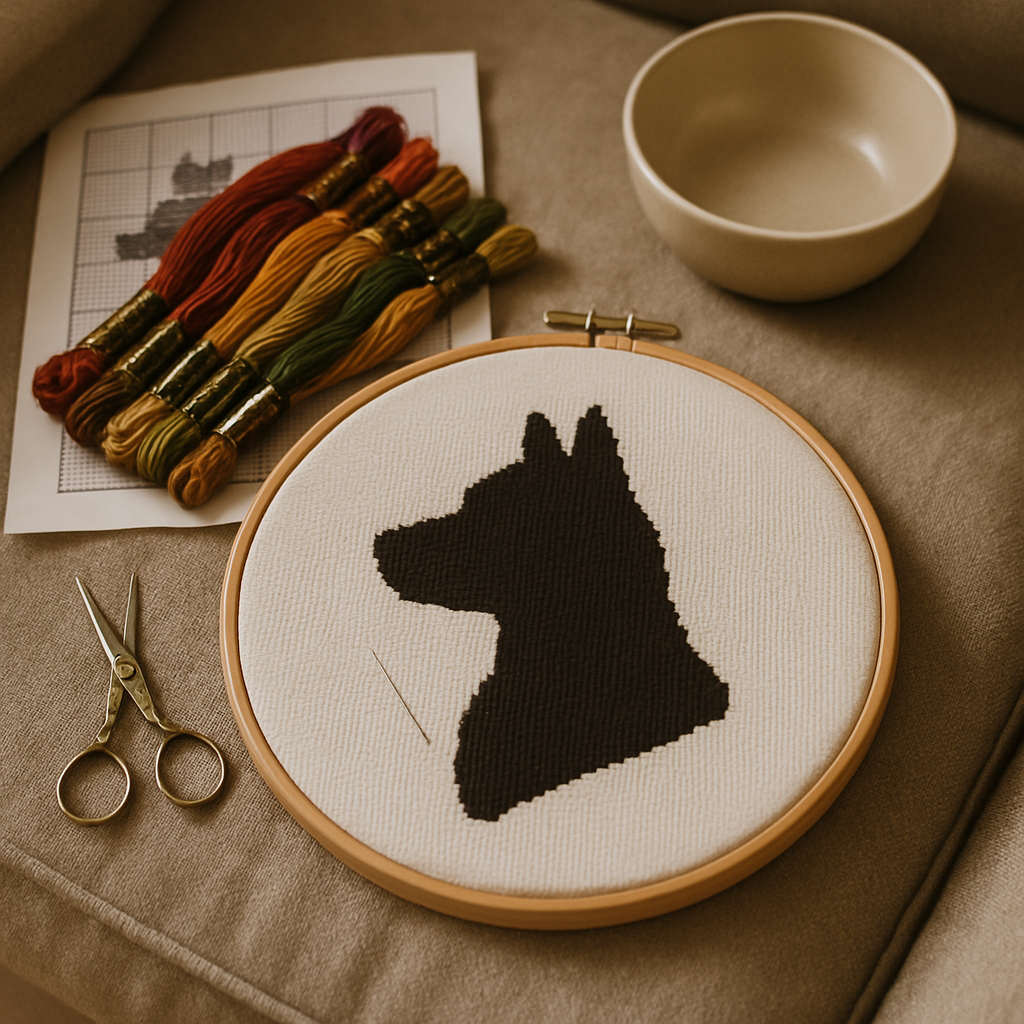
There's a particular kind of quiet that settles in after a pet dies. The food bowl you haven't put away. The spot on the couch. The way the house sounds different. For a lot of us, the urge that follows is to make something — to turn all that love, now with nowhere to go, into something we can hold and keep.
A cross-stitch portrait is one of the most fitting ways to do that. It's slow on purpose. Every stitch is a small act of attention, and by the time the piece is finished, you've spent many hours simply being with their face again. This guide will help you make one — gently, and well — whether you're an experienced stitcher or someone picking up a needle for the first time because this, specifically, is the thing you need to make.
Take your time with it. There's no rush here.
Why cross stitch is a fitting way to remember a pet
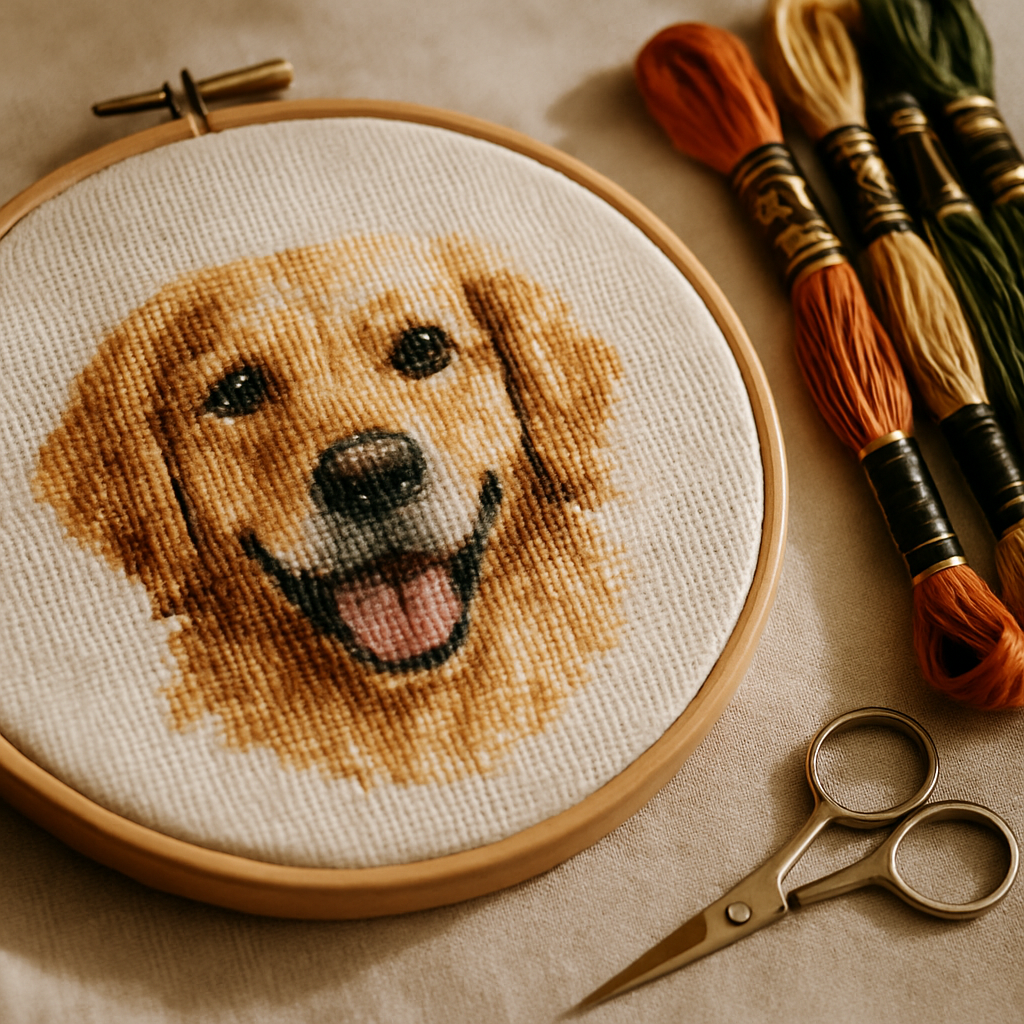 A photo on your phone gets scrolled past. A framed, hand-stitched portrait stops you. It carries the weight of the time it took — and that time is part of the point. Many people describe the stitching itself as comforting: the rhythm of it, the focus, the way an hour at the hoop with your dog's portrait can feel like a quiet visit.
It also lasts. A well-made cross-stitch piece can hang on a wall for decades, becoming the thing your family points to and tells stories about. It's a tribute that ages into an heirloom.
Start with the photo — even an imperfect one
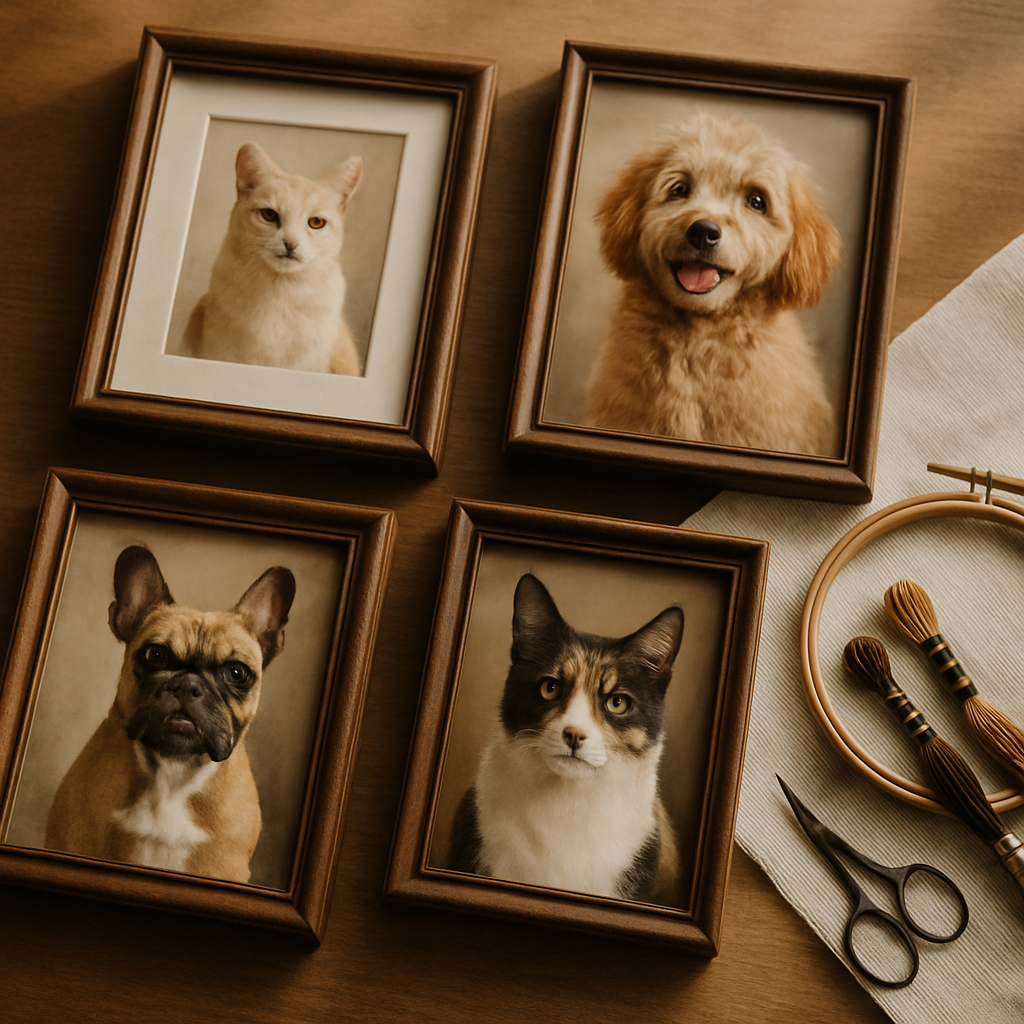 Everything begins with the photo, because the photo is what carries their likeness into the thread. If you're choosing from a lifetime of pictures, you have a wonderful problem. If you have only a few — or only one — please know that's often enough.
Choosing the photo that captures them
Look for the photo where their expression is most them — the head tilt, the soft eyes, the particular look they gave you. Technical quality matters, but expression matters more, because that's what people will recognize. Within the photos that capture their character, favor the one that is:
- Sharpest in the eyes. The eyes are where a portrait lives.
- Well-lit on the face, without deep shadow swallowing their features.
- Close enough that their face fills a good part of the frame.
A simple background helps too, but don't rule out a beloved photo just because the background is busy — that's one of the easier things to set right later. (Our guide to photographing a pet covers what makes a strong source image, if you happen to have time to take new photos.)
When the only photo isn't great
This is the hardest version, and the most common: the photo you have is precious and imperfect. It's grainy, or dim, or years old, and it's all there is. There's a real tenderness to this — the stakes feel enormous because you can't reshoot.
Here's the honest, comforting truth: imperfect photos make beautiful memorial pieces all the time. You don't feed the photo in raw and hope — you work with it, gently. Crop in close to concentrate the detail that exists. Lift the contrast to recover their features from the shadows. Quiet a distracting background so every stitch belongs to them.
If the photo is all you have left Start from the picture where their eyes are clearest, even if it's small or old. Crop close to the face, raise the contrast a little, and simplify the background. You're not trying to make a perfect photo — you're preserving the expression you remember. That's what will make people say that's really them.
StitchThis's built-in image tools are made for exactly this kind of careful preparation — automatic background removal, contrast enhancement, and the ability to merge two photos if, say, the best face is in one picture and the best pose in another. None of it invents detail that was never there, but thoughtful prep routinely turns a so-so photo into a portrait that genuinely holds your pet's likeness.
Making it truly theirs: personal touches
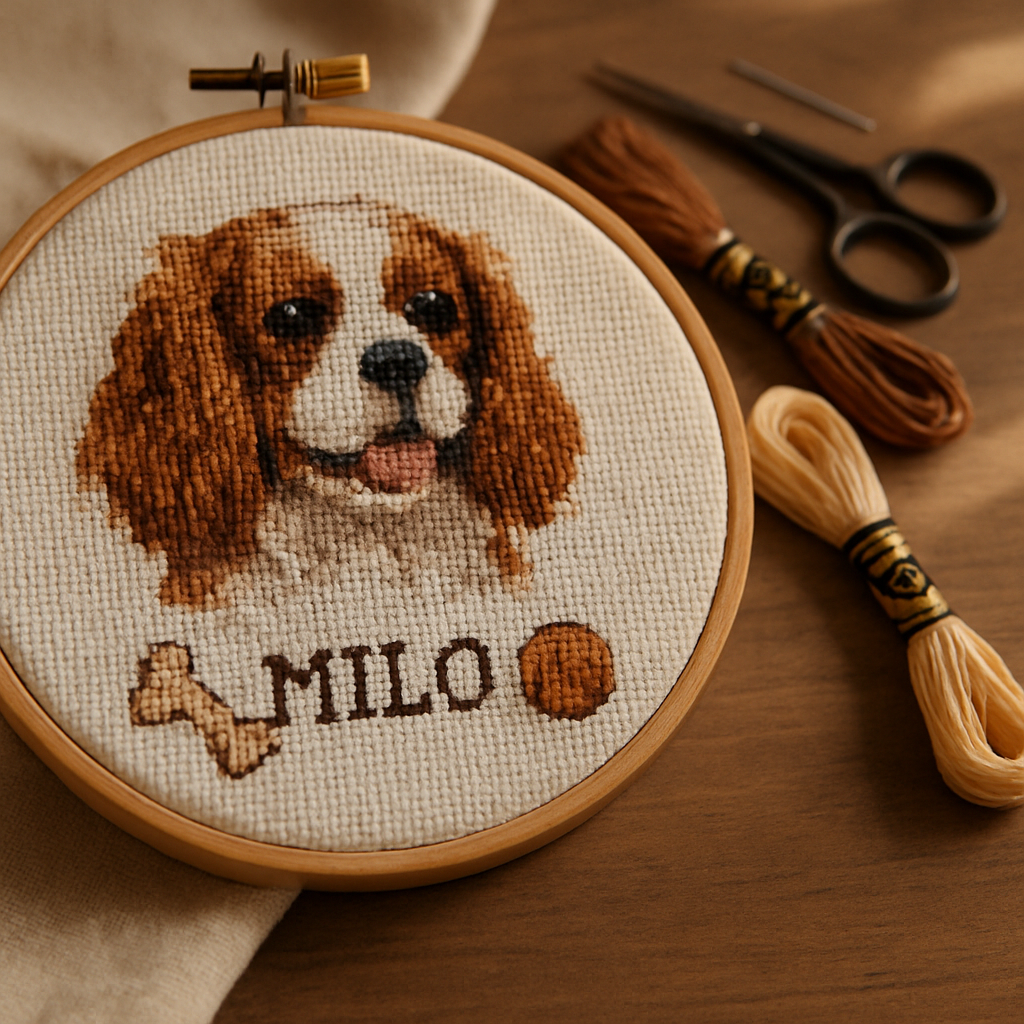 A memorial piece becomes powerful when it's unmistakably about your animal, not a generic dog or cat. A few additions go a long way.
Name, dates, and words
The simplest and most common: their name, often with their years (2009–2024). Some people add a short line — "Always by my side," a favorite nickname, or just "Good boy." Keep it brief; the portrait should lead, the words should whisper.
Paw prints, collars, and favorite things
Small symbols carry enormous meaning. A single paw print. The exact color of their collar. The squeaky toy they carried everywhere. The blanket they slept on. These details are what make a viewer's breath catch — they say someone knew this animal.
"Rainbow bridge" and other motifs — done meaningfully
The rainbow bridge is a beloved motif in pet loss, and it can be lovely. The trick is to make it personal rather than generic — a soft arc of color behind your pet's portrait says more than a clip-art rainbow with a stranger's silhouette. Let any motif support their likeness, not replace it.
Meaningful details to consider including
- Their name and years
- A paw print (or their actual paw print, scanned)
- Their collar color or tag
- A favorite toy, ball, or blanket
- A short phrase, nickname, or single word
- A subtle background in their favorite color
Keeping the likeness: why the eyes matter most
If there's one thing that separates a memorial piece that looks like them from one that doesn't, it's the eyes. A naive photo conversion treats a face the same as a background — it scatters everything into confetti, and the first casualty is the expression. The eyes go flat, the face muddies, and the result is recognizably a dog but not your dog. (This is the most common reason a finished portrait disappoints.)
This is the part worth getting right, because it's the whole reason you're making the piece. When you convert your photo on StitchThis, StitchSense holds detail where the eye lands — the eyes and face — while gently simplifying the busier areas like fur and background. The expression survives the journey into thread, which is exactly what you want from a tribute.
If you'd like to fine-tune by hand afterward, the in-browser viewer doubles as a chart editor — adjust individual stitches around the eyes until it feels right, paint or fill new stitches with the draw tools, swap one color for another across the whole chart, and add their name and dates with the freehand designer before you export. The legend can be rendered in any of six floss brands (DMC, Anchor, Cosmo, Gamma, Madeira, or Metro), and if you've imported your stash — by CSV from a spreadsheet, or by photographing your skein organizer — the pattern matches against what's already in your floss drawer. The pipeline lands as a clean professional PDF with your chosen palette, your name, and your dates ready to print and stitch. The same combination — focal-detail preservation, brand-matched legend, stash-aware generation, post-generation chart editing — is what separates a memorial portrait that captures your animal from one that catches only their outline.
Should you stitch it yourself or commission it?
There's no wrong answer here, only what's right for you right now.
| Stitching it yourself | Commissioning it |
|---|---|
| The making becomes part of grieving and healing | Spares you the work if grief makes it too hard |
| Deeply personal; every stitch is yours | A finished piece by an experienced hand |
| Costs mainly your time and materials | Costs more; supports a maker |
| Doable even as a beginner, with patience | Good when you want it perfect without the labor |
Many people find that making it themselves is the entire point — the hours are how they say goodbye. Others are too raw, or too busy, and a commissioned piece (or a pattern you have made and then stitch, or gift) is the kinder path. Both honor the animal. If you're making a tribute as a gift for a grieving friend, a finished or commissioned piece is often the gentler choice. (Designers who create these for others can read more in our guide to pet portrait cross-stitch.)
Choosing fabric, size, and framing for a keepsake
A memorial piece is meant to last and to be displayed, so it's worth a few deliberate choices:
- Fabric count: A higher count (16 or 18) lets you capture finer facial detail in a smaller space, which suits a portrait. A lower count (14) is easier on the eyes and hands if you're a beginner.
- Size: Bigger isn't always better. A tightly framed face at a moderate size often reads more powerfully than a large, sparse scene. Use a fabric size calculator to see how your stitch count translates to finished inches before you start.
- Framing: Invest in framing here. A clean mat and a quiet frame turn a stitched portrait into a piece of art worthy of the wall.
New to all of this? Our beginner's guide walks through the basics so you can focus on the piece that matters.
The stitching itself: letting the process help
Allow yourself to feel whatever comes up at the hoop. Many people cry over the eyes and laugh over the ears. Some stitch a little each evening as a ritual; others can only manage a few minutes at a time at first. There's no correct pace for grief, and there's no correct pace for this.
If you make a mistake, it's okay. A tiny imperfection in a handmade tribute isn't a flaw — it's evidence of the human hands that made it out of love.
A gentle step-by-step to begin
When you're ready — and only then:
- Choose the photo where their expression and eyes are clearest.
- Prepare it kindly — crop close, lift contrast, simplify the background.
- Convert it into a pattern that keeps the eyes and face intact.
- Add the personal touches — name, dates, a paw print, their collar color.
- Pick fabric and size suited to a lasting keepsake.
- Stitch at your own pace, and let the hours be what they need to be.
- Frame it and give it a place in your home.
A quiet place to start, free If you'd like to see your pet as a pattern, you can create one on StitchThis for free. Upload the photo, prepare it gently, and see their face take shape in stitches whenever you feel ready.
Frequently asked questions
Can I make a memorial cross-stitch from an old or blurry photo? Often, yes. Crop closely to the face, raise the contrast, and simplify the background to make the most of the detail that's there. It won't match a fresh, perfect photo, but careful preparation regularly produces memorial portraits that truly capture a pet — which is what matters most.
Should I make the memorial myself or have someone make it? Both are valid. Many people find that stitching it themselves is part of healing, and it's doable even for beginners. If grief makes the work too heavy, or you're making it for someone else, a commissioned or finished piece is a kind and worthy alternative.
What should I include in a pet memorial cross-stitch? At minimum, their portrait and name. Many people add their years, a short phrase, a paw print, their collar color, or a favorite toy. The most moving pieces include a small detail that only someone who loved that animal would think of.
How big should a pet memorial piece be, and how long does it take? A moderate, tightly framed portrait usually reads more powerfully than a large, sparse one. Time depends on size and fabric count, but a memorial piece is rarely something to rush — give it the time it asks for.
I've never cross-stitched before. Can I still do this? Yes. Plenty of people learn specifically to make a tribute to a pet. Start with a manageable size and a forgiving fabric count, and lean on a beginner's guide. The love in the making matters more than perfect technique.
I want to make one as a sympathy gift for a friend who lost a pet. Any advice? Use a photo where the pet's expression is clearly them, and keep added text simple and gentle. If time or skill is a barrier, a commissioned piece is thoughtful too. A handmade tribute to a friend's pet is among the most touching gifts you can give.
A small, lasting goodbye
Grief doesn't really end; it changes shape. A cross-stitch portrait gives some of that love a place to live — on the wall, in your hands during the quiet hours, in the story your family tells when someone asks about the dog in the frame. Choose the photo where their eyes are clearest, make it unmistakably theirs, and let the stitching be as slow and tender as it needs to be.
Whenever you feel ready, you can begin a portrait of your pet on StitchThis for free — no cost to start, and all the time in the world to finish.
How StitchThis converts your photo into a faithful pattern
Photo-to-pattern conversion is exactly where most tools fall down — they treat every pixel the same, scatter the detail evenly across the image, and the result is a chart that looks correct in thumbnail and unrecognisable on the fabric. StitchThis is built around the opposite principle: StitchSense preserves detail where the eye reads expression (faces, eyes, focal subjects) and simplifies the areas where the eye doesn't notice. Confetti drops dramatically, the focal subject stays recognisable, and the chart respects what stitching can actually render on your fabric count.
The same generator hands you the rest of the project at once. The legend renders in any of six floss brands — DMC, Anchor, Cosmo, Gamma, Madeira, Metro — so the pattern arrives in the brand you actually own. The floss stash tracker can be imported via CSV from an existing spreadsheet or by photographing your skein organiser, and the pattern then filters its shopping list against what's in your floss drawer. The in-browser viewer doubles as a chart editor — paint, fill, change-all colour replacement, half-stitch and backstitch tools — so you can fine-tune cells around the eyes or other focal areas before you commit a single stitch. Studio-tier users add FORGE batch generation for several variations from the same source image. Everything exports to a clean PDF when you're done. From pattern creation through floss tracking to in-browser viewing and editing — plus a community of stitchers around it — StitchThis is the whole pipeline in one place.
Try StitchThis free — upload a photo, pick a brand, see your pattern in a few minutes.
Related reading on StitchThis:
- Memorial Cross-Stitch Patterns: A Thoughtful Guide to Honoring Someone You Loved — the broader memorial pillar, with extensive guidance on symbols, words, and design choices that apply to pet pieces too.
- How to Photograph Your Pet for a Cross-Stitch Pattern — the source-photo principles that determine how recognizable the final portrait will be.
- Free Cross-Stitch Patterns from Your Own Photos — the photo-to-pattern workflow walked through end to end.
- Why Some Cross-Stitch Patterns Feel Miserable to Stitch — the focal-detail concept that matters most on portrait work.
- Cross-Stitch Family Portrait Pattern Guide — for memorial pieces that include people alongside the pet.
- How to Sell Pet Portrait Cross-Stitch Commissions — for stitchers and designers offering memorial commissions.
- Cross-Stitch for Beginners: How to Read a Pattern — if this is the project you're learning the craft for.
- DMC vs Anchor Floss: Conversion Chart, Quality Comparison, and Pro Tips — palette and brand choice.
- Aida 14 vs 16 vs 18: The Complete Fabric Count Guide — fabric count for portrait work.
- How Much Floss Do I Need? Cross-Stitch Floss and Fabric Size Calculator Guide — practical sizing math.
Ready to turn your photo into a cross-stitch pattern?
Try StitchThis freeTwo patterns per month. No card required.