Memorial Cross-Stitch Patterns: A Thoughtful Guide to Honoring Someone You Loved
A caring guide to memorial cross-stitch patterns — what to include, how to work from an imperfect photo, design ideas, and the stitching itself as part of remembering.
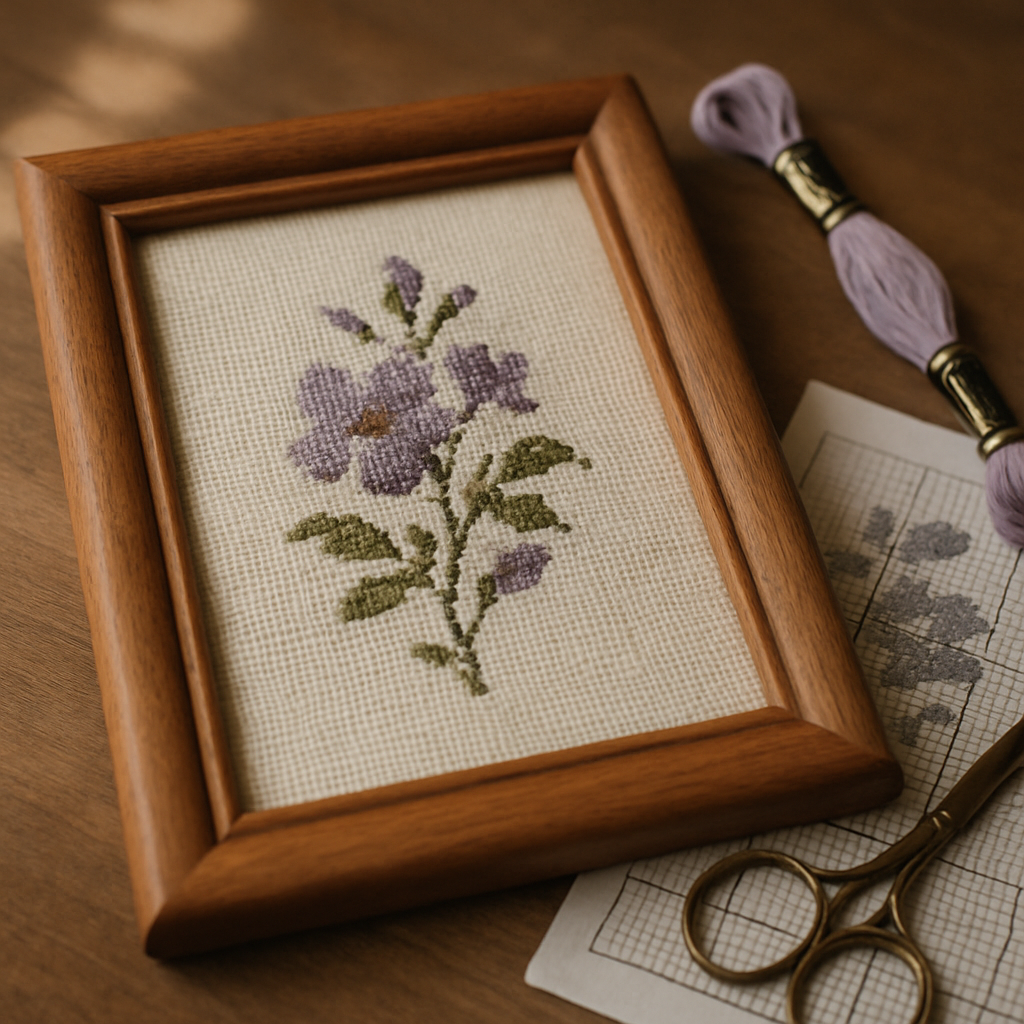
There's an instinct most stitchers recognise. Someone you loved has died — recently, or longer ago than you'd like to admit — and somewhere in the slow work of grief comes the small, persistent thought: I want to make something that lasts. Not a card. Not a Facebook post. Something with your hands, that takes hours and hours, that you can finish and frame and look at, and that will still be there in twenty years when whoever inherits it asks who she was.
For a lot of people, that thing is a cross-stitch.
This guide is for the stitcher (beginner or experienced) sitting with that instinct, trying to figure out what to make and how to start. It covers the practical parts honestly — choosing what to include, working from the photo you have rather than the one you wish you had, design elements that make a memorial piece personal rather than templated, and the practical sizing and fabric decisions. It also speaks gently to the harder part: the stitching itself, as a way of remembering.
If you are making this for a pet rather than a person, the principles are the same; the specifics differ, and the pet memorial cross-stitch pattern guide covers them in depth. Both pieces are part of the same family of decisions.
Why cross-stitch fits the moment
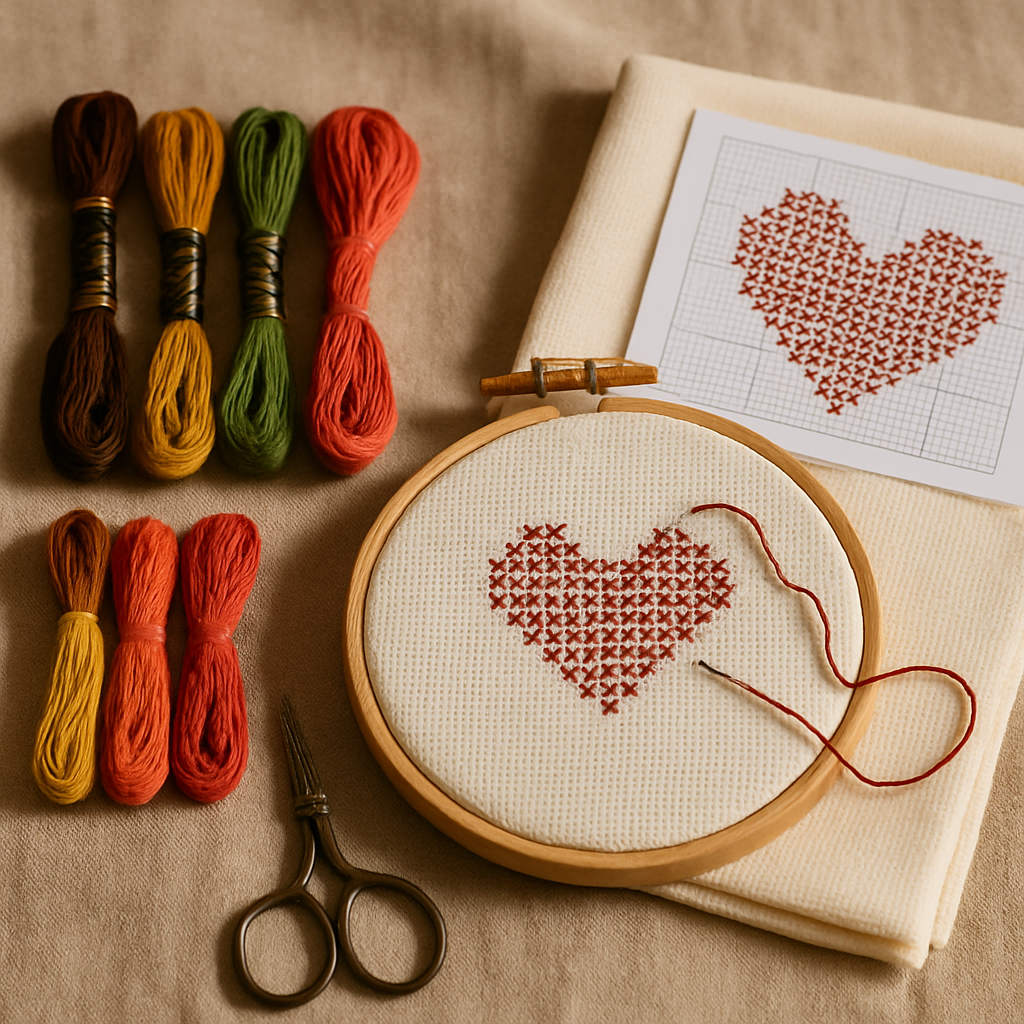 There are quicker ways to honor someone. A printed photo in a frame. A digital slideshow. A commissioned painting. Cross-stitch is none of those things — and for many people, that is exactly the point.
Cross-stitch is slow. A modest portrait or sampler takes weeks of evenings; a larger piece takes months. During those hours, your hands are occupied with small repetitive motion and your mind is free to wander — to remember, to be sad, to laugh at something they used to say, to be quiet. The piece itself becomes a vessel for that time, and the time becomes part of what the piece is.
It is also durable. A well-stitched and well-mounted piece outlives the people who made it. Memorial samplers from the 1700s and 1800s are in museums; ones from the 1980s are in attics, waiting to be rediscovered. What you make is going to be around long after you and the person it honors are both gone, and someone who hasn't been born yet may be the one who finds it.
For people who don't know what to do with grief in the first hard weeks or months, that combination — slow time, lasting object — is what makes cross-stitch fit. It's not the only thing that fits, and it's not for everyone. But if you've felt the pull, that pull has a reason.
Choosing what to make
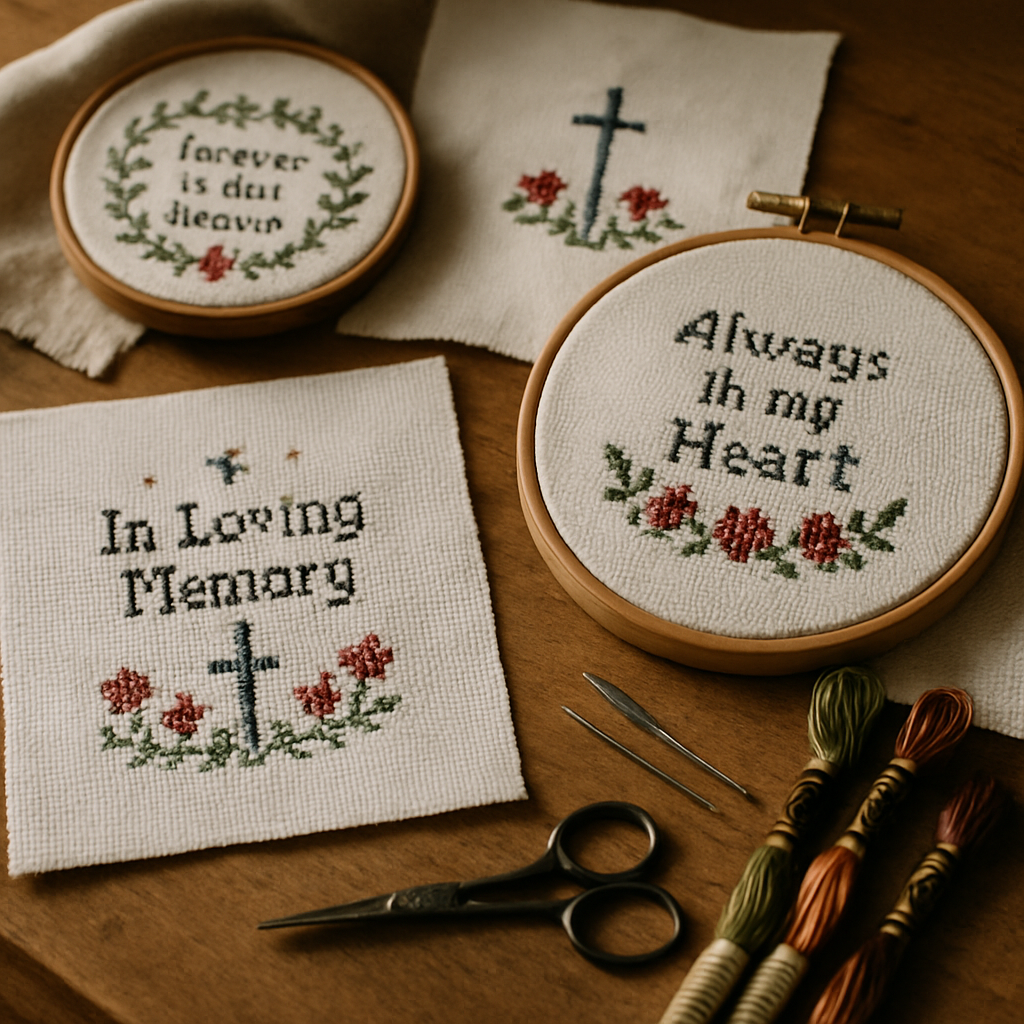 Memorial cross-stitch tends to fall into three loose categories. None is "better" than another; the right choice depends on you and the person.
Portrait pieces render the person (or pet) themselves from a photo — a face, a half-body image, sometimes a scene. These are the most demanding to design and stitch, and the most personal when they work. They look unmistakably like the subject and almost nothing else. They are also the most vulnerable to getting wrong, because the gap between "looks like them" and "doesn't quite" can be brutal on a memorial piece.
Symbol pieces use traditional motifs — a rose, a willow tree, a dove, an anchor, a single candle, a butterfly, a tree of life — as the visual focal point, with the person's name and dates rendered in lettering. These are easier to stitch beautifully and harder to get wrong, because the design's recognition value comes from the symbol rather than from likeness. They also leave room for elements that feel meaningful in your tradition or theirs — religious symbols, vocational symbols, hobby motifs.
Word pieces center on text — a quote they were known for, a hymn or scripture, a lullaby, the lyrics of a song that played at their service, a line of poetry that catches who they were. The lettering itself becomes the design. These often pair with a small symbol or border, and they are the simplest to design and stitch well.
Many memorial pieces blend two or all three: a portrait with their name and dates below it; a willow tree with a verse stitched alongside; a symbol piece with a quote. There is no single right form.
If you're not sure which direction to go, start by writing down three or four things that genuinely feel like them — a thing they always said, a flower they loved, a place that mattered, a job they did, a faith or absence of one. The piece that takes shape around those notes will be more theirs than any template you find online.
Working from an imperfect photo
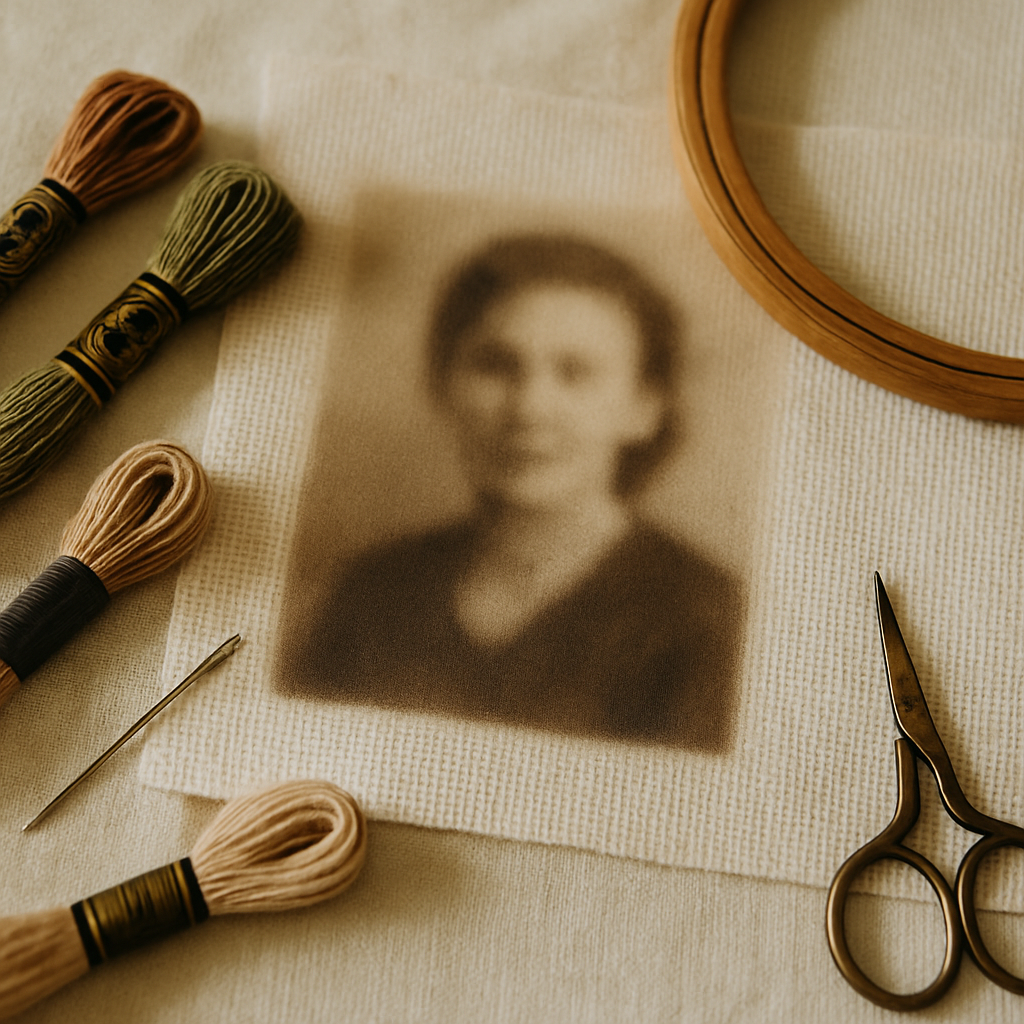 If you decide on a portrait piece, the photo problem will be the first and hardest thing you face. The photo you have is rarely the one a portrait artist would choose. It might be old. It might be slightly blurry. The lighting might be wrong. The subject might not be looking directly at the camera. It might be the only photo of them from the last year of their life, taken on someone's phone, and you cannot get another.
This is the part of the process where people get stuck. They convince themselves that because the photo isn't good enough, the project can't happen. That's almost never actually true, and it's worth being clear about why.
A cross-stitched portrait is not a faithful pixel-for-pixel rendering of a photo. It's a stylized translation — squares of color on a grid, viewed from a few feet away. The eye is enormously forgiving of the gap between "what the photo showed" and "what the stitch rendered." What matters in a memorial portrait is whether the subject's expression and the things that made them recognizable are preserved. Eye position, eye color, the shape of a mouth, the angle of the head, the way light falls across the face — these are the things people read first when they see a portrait. The fact that the photo's resolution was 800×600 instead of 4000×3000 is much less important than whether those expressive elements survive the conversion.
The risk with photo-to-pattern conversion on portrait work isn't the source photo's quality. It's the conversion's quality. Naive pattern conversion treats every pixel the same — a pixel in the cheek, a pixel in the iris, a pixel of background noise are all rendered with equal weight. The result is a chart where focal detail (the eyes, the mouth) is sprinkled across the background as much as it is across the face. Confetti everywhere, and the subject's recognizability lost to noise. This is what makes naïve photo-converted portraits look "off" in a way the original photo didn't.
Better photo conversion preserves detail where it matters — focal subjects, faces, eyes — and simplifies what's behind it. The chart that comes out doesn't try to render every pixel; it renders the parts of the image the eye actually lands on. The background reduces to a few clean shades; the face holds its color budget; the eyes keep the detail that makes a portrait recognizable as the person rather than as a stranger.
StitchThis is built around this idea. Its quality engine (we call it StitchSense) keeps detail where the eye reads expression — eyes, faces, focal subjects — and simplifies areas where the eye doesn't notice. For memorial work, where the entire point is that the finished piece looks like the person you loved, this is the difference that matters. It's the same principle that drives the pet memorial guide — pets and people are subject to the same focal-detail problem.
A few practical notes for working with the photo you have:
- If the photo is dim or off-color, that's something the conversion tool can adjust before the chart is generated. Brightness, contrast, white balance — small corrections to the source image often improve the final pattern more than any chart-level tweak.
- If the photo has busy background you don't want in the piece, background removal at the image-prep stage is far cleaner than trying to stitch around it later.
- If the subject's eyes aren't quite open, or the angle isn't ideal, sometimes the best move is to find a different photo from another period of their life. The "most recent" photo isn't always the most "them."
- If the photo has someone else in it (a hand on a shoulder, a co-subject), and you want only one person in the piece, cropping is your friend.
For deeper guidance on preparing a source photo — composition, lighting, the technical details that turn a casual snapshot into a usable pattern source — how to photograph your pet for a cross-stitch pattern covers the principles. They apply identically to portraits of people, with the practical difference that the photo you'll work from has often already been taken and cannot be reshot.
Design elements that make a memorial piece personal
Whether you're making a portrait, a symbol, or a word piece, a few small design choices are what turn a generic memorial into something specifically theirs.
Names and dates. Almost every memorial piece includes the person's name and their birth and death dates. The convention is to render these in a serif lettering style ("Anna Marie Whitfield / 1948–2024" or similar). Some traditions use only the year; some include the full dates. The lettering can be plain and dignified, or it can pick up a flourish or two if their personality was the kind that wanted some flourish.
A line of text. A quote, a scripture verse, a hymn line, a song lyric, a phrase they used. One stitcher I knew memorialized her grandmother with "Don't forget your gloves" stitched at the bottom of the piece, because her grandmother said it every time she left the house. That sort of specific detail is what separates the piece from one that could have been for anyone.
A symbolic element. Roses, doves, willow trees, butterflies, candles, anchors, and crosses (in various traditions) are the most common. Less common but often more personal: a tool from their trade, a flower from their garden, an instrument they played, a card from the deck they always played with, the breed of dog they always had, the boat name they sailed under.
Their handwriting. If you have a sample — a letter, a recipe card, a signature — a piece that incorporates their actual handwriting feels different from one that uses a font. Tracing a signature into a freehand pattern is possible with most pattern-editing tools, and the result reads as deeply personal.
Color choices that meant something. The color of their favorite sweater. The color of the curtains in the house you grew up in. The color of their team. Memorial pieces don't have to use traditional muted tones if the person wasn't a muted-tone kind of person.
Their voice somewhere. A quote in their own words, transcribed verbatim from a recording, or a phrase they said often enough that everyone in the family can hear them saying it. Even tiny things — "Well, that's that" or "All right, then" — read as specifically them when read by the people who knew them.
None of this requires special design software. A pattern-creation tool with a freehand designer alongside the chart editor lets you assemble these elements yourself rather than buying a template — the symbol you want, the lettering you want, the colors that mean something. The piece becomes a portrait of your relationship to the person, not just a portrait of the person.
The stitching itself
If you have stitched anything before, you already know what cross-stitch does to time. The hours stretch out in a way that's hard to describe to people who haven't done it. You sit with the work and your hands stay busy and your mind is somewhere between focused and free.
For grief specifically, this is part of what the project gives you. The first weeks after a loss are loud — phone calls, paperwork, well-meaning visitors. Then they aren't loud anymore. The quiet that comes after is the harder part for many people, and it's the part that doesn't go away on a predictable schedule. A long handwork project gives the quiet a shape. It gives you something to do with your hands that doesn't ask you to talk or to be a certain way. It also gives you a measurable accumulation — the piece is bigger this week than it was last week — which is a small, concrete kind of progress in a season where most progress feels invisible.
People who finish memorial pieces often describe the time at the hoop as part of how they grieved. Not the whole of it, and not a substitute for grief, but a component — the hours of slow, repetitive, meaningful work that helped them metabolize what happened.
This is also why finishing matters. A memorial piece that gets to 60 percent and then stalls in a drawer for years is heavier to look at than the one that's framed on the wall. If a pattern turns out to be miserable to stitch — confetti, an over-segmented palette, dense fractionals — that's the pattern's fault, not yours, and it's worth picking a more stitchable pattern and starting over rather than slowly grinding through one that's stealing the time the piece was supposed to honor. Why some cross-stitch patterns feel miserable to stitch covers what to look for in a pattern that's going to be good company for the long hours ahead.
Memorial pieces as gifts for grieving friends
If you are stitching for a friend who lost someone — not for yourself — the considerations shift. The piece will be theirs to display or store as they choose, and your job is to honor what they'd want, not what you'd want.
A few things that tend to work:
- Ask, gently and once. "Would you like a small framed piece in memory of [name]?" gives them the option without obligation. Some people will say yes immediately; some will need time before they're ready to know what to say; some will say no, and that's also a real answer.
- Subject matter that's safe. A symbol, a hymn line, a meaningful quote. Portrait pieces of someone the recipient lost can be either deeply meaningful or painfully difficult to display, depending on the person and the timing. If you don't know which, go with a symbol or text piece.
- Smaller is better. A 4×6 inch hoop piece is easier to receive than a 20×30 inch framed portrait. The recipient can put it on a shelf, in a drawer, on a desk; they have options. A large piece needs wall space they may not have, and the obligation to display it can become its own weight.
- A note explaining the choices. If you stitched in the colors of the deceased's favorite sweater, or used a quote you found in their letters, write a small note that comes with the piece explaining why. Future generations of the family will treasure that context as much as they treasure the piece.
The gift is the time you spent making it as much as it is the object itself. The recipient will know that, and the time is what they will thank you for.
Practical considerations
A few specifics that affect every memorial piece:
Fabric color. Cream, ivory, and off-white are the traditional choices and pair well with most palettes. Black fabric is sometimes used for high-contrast portrait work, especially for darker palettes. Avoid stark white if the piece is meant to look like a heirloom rather than a contemporary craft; cream reads as warmer and more enduring.
Fabric count. 14 or 16 count Aida is the most common for memorial pieces because they're a comfortable working count that produces a satisfying density of stitches. Portrait pieces benefit from 18 count or 28 count linen over 2 (effectively 14 count math) where you want finer facial detail. For an in-depth comparison of how the counts differ, see Aida 14 vs 16 vs 18: The Complete Cross-Stitch Fabric Count Guide.
Palette and color choice. Memorial pieces are often rendered in muted tones — soft greens, dusty pinks, off-whites, sepias. There's no rule that they have to be. If the subject was vibrant, the piece can be vibrant. The convention exists because muted palettes age well and read as timeless; the convention does not exist because grief is grey.
Floss brand. Whatever you have or can easily get. DMC and Anchor are the global defaults; Cosmo is excellent for subtle skin tones and gradients. If the piece is going to be heirloom and you're making it now from your existing stash, knowing what you have on hand matters. StitchThis's floss stash tracker lets you import an existing inventory — by uploading a CSV from a spreadsheet, or by uploading a photo of your skein organizer for the tracker to identify the colors — so the pattern that gets generated is filtered against what's actually in your floss drawer. For a deeper look at brand choice and substitution, see DMC vs Anchor floss: conversion chart, quality comparison, and pro tips.
Frame size and display. Memorial pieces are often framed under glass with a matted border, which protects the stitching and presents the piece formally. Hoop displays are also fine and tend to feel softer; they suit smaller pieces and informal displays. A piece in a drawer is honored less than one on a wall, so think about where it will go when it's done, and let that influence the size.
Edge and finishing details. A handful of stitchers stitch the names and dates of the deceased in tiny lettering on the back of the piece — invisible to the viewer but present in the work. Others sign and date the piece on the back as a maker's mark. These small private gestures don't show in the framed piece but mean a lot to the maker.
When the project feels too big
If you are early in grief and the idea of starting a six-month portrait project feels impossible, that's a real signal. Start smaller. A single-evening project — a small symbol piece, a short line of text — can be its own complete tribute, and finishing it gives you something you can look at and be glad you made. The big portrait can come later, or never. The smaller piece is enough.
You can also work in pieces. A small heart with the person's initials, finished in a weekend, is a complete object. If a year later you want to make a portrait, you can; the small piece is no less meaningful for being smaller.
The work should serve the remembering. If it is asking you to climb a mountain you don't have the strength for right now, climb a smaller hill, and let the smaller hill be its own thing.
A note on pet memorials
The principles in this guide apply equally to memorials for pets. The grief is different and the same — fewer of the social structures around human grief exist for pet loss, and many people feel the absence of those structures as part of the pain. A cross-stitched memorial for a pet is a quiet, specific, lasting answer to that absence.
The pet memorial cross-stitch pattern guide goes into the specifics — rainbow bridge symbolism, paw prints, breed-specific considerations, working from the photos pet owners tend to have (phone snapshots, candid moments, the dog asleep in a sunbeam). The practical work of preserving expression from an imperfect photo is the same; the cultural conventions are slightly different.
FAQ
Can I make a memorial cross-stitch if I'm a beginner? Yes. Many people who start cross-stitch begin specifically to make a memorial piece. For a first project, a small symbol or word piece — a heart, a name and dates, a short quote — is more manageable than a full portrait and produces a complete object you can frame. Start with that. The portrait can come later if you want.
How long does a memorial cross-stitch take? A small symbol or word piece can be finished in a weekend or two. A modest portrait takes several weeks of evening stitching. A larger portrait can take three to six months. Memorial work is rarely on a deadline, so the time the project takes is part of what it gives you. How much floss do I need? Cross-stitch floss and fabric size calculator guide covers the math for planning the project's size before you start.
What should I put on a memorial cross-stitch? The person's name and dates are conventional; everything else is personal. Common elements: a meaningful quote, a hymn or scripture, a symbol that mattered to them or in your tradition (rose, dove, willow, cross, anchor, candle), a hobby or vocational reference, a sample of their handwriting. The piece is more theirs when it includes specifics from their life rather than generic memorial imagery.
Is it appropriate to make a memorial cross-stitch from a photo someone else took? Yes. Cross-stitched portraits derived from a photo are not considered to compete with the photo as a creative work; they are clearly a derivative interpretation. For commercial or commission work, a permission conversation is worth having; for personal memorial pieces you're making for yourself or for family, this is rarely a concern.
Can I sell memorial cross-stitch patterns or finished pieces? You can. Many designers and stitchers make commission memorial portraits and patterns. Memorial commissions are an emotionally demanding category of work — clients are grieving, the stakes feel enormous to them, the timelines are flexible but the quality bar is uncompromising — and they require a different kind of customer-service skill than typical commission work. If you're a designer considering this, the designer's guide to pattern testing covers the workflow principles that apply.
How do I store a memorial piece while I'm working on it? Keep it in a clean cotton drawstring bag between sessions, away from sunlight, smoke, and pets. Avoid plastic for long-term storage (it can off-gas onto the fabric over years). Wash your hands before each session; the natural oils on hands accumulate over weeks of work and can dull the floss colors slightly. Once finished, the piece should be hand-washed gently in cool water with a mild soap, blocked flat to dry, and framed or finished within a reasonable time after completion.
Is it weird that I want to make a memorial cross-stitch instead of just grieving normally? No. People do many things with grief — make scrapbooks, plant gardens, write letters to people who can't read them, donate to causes the person cared about. A handmade tribute is one of the oldest forms of memorial that exists. The instinct to make something is healthy and human.
You can begin
If you are sitting with the instinct to make something, you can begin. Pick the form first — portrait, symbol, or words. Pick the size you can finish; smaller is fine. Pick the elements that feel like them — a quote, a flower, a name, a date, a phrase they said. Choose a fabric and a brand of floss that work with what's in your stash. Find or generate a pattern that respects what stitching can actually render — clean color blocks, sensible palette, focal detail where the eye lands.
For the photo-to-pattern part, the conversion tool matters more than almost any other choice you'll make, because portrait work is where the difference between a faithful render and a noise-scattered mess is most visible. If you want to try StitchThis free, Pattern creation, floss stash tracking, an in-browser viewer + chart editor, and a community of stitchers all in one place — that's the StitchThis workflow. You can upload the photo you have, prepare the image (contrast, background, framing), generate a pattern that preserves focal detail, and check the chart in the viewer before you cut any fabric. Two patterns is enough to experiment — generate a small symbol piece first, then a larger portrait once you've felt how the tools work.
Whatever you make, however long it takes, the piece will be there in twenty years. So will the memory of the person you made it for.
Related guides
If you're working through related decisions, these are the companion pieces. Take them in any order — there's no path you're supposed to walk.
Other personal and tribute pieces
- Pet Memorial Cross-Stitch Pattern Guide — the same principles, adapted to the specifics of pet loss.
- Cross-Stitch Family Tree Patterns: How to Design a Custom One — layout, lettering, and fitting every name and date you want to include.
- Cross-Stitch Anniversary Patterns: Year-by-Year Ideas — pieces marking the long arcs of a relationship; the year-by-year traditions, plus how to make them personal.
Working from a photo
The conversion choices for a memorial portrait are the same ones you'd make for any portrait work — the difference is the stakes, not the technique.
- How to Photograph Your Pet for a Cross-Stitch Pattern — source-photo principles that apply equally to portraits of people.
- Free Cross-Stitch Patterns from Your Own Photos — turning a personal photo into a chart.
- How to Make a Cross-Stitch Pattern from a Wedding Photo — the techniques transfer cleanly to memorial portrait work.
- Cross-Stitch Family Portrait Pattern Guide — when the memorial includes more than one person.
If this is your first cross-stitch project
- Cross-Stitch for Beginners: How to Read a Pattern — the foundation if you're new to the craft. Start here.
- Aida 14 vs 16 vs 18: The Complete Fabric Count Guide — the right fabric count for portrait work (usually 16 or 18).
- How Much Floss Do I Need? Floss & Fabric Size Calculator — practical sizing math before you cut fabric.
- Why Some Cross-Stitch Patterns Feel Miserable to Stitch — what to avoid so the stitching is good company for the long hours.
Other practical pieces
- DMC vs Anchor Floss: Conversion Chart and Pro Tips — when the palette pulls colors you don't have, or comes in a different brand than your stash.
- Cross-Stitch Pattern Maker for Mac (Definitive Guide) — browser-based pattern creation that works on every platform.
- The Designer's Guide to Pattern Testing — for designers considering memorial commission work.
Ready to turn your photo into a cross-stitch pattern?
Try StitchThis freeTwo patterns per month. No card required.